Interdum stultus opportuna loquitur...

Tuesday, August 31, 2004

Eeeek! Oh... wait... Yaaaaay!

Note - from June 24th 2009, this blog has migrated from Blogger to a self-hosted version. Click here to go straight there.

Gee things looked shaky mid-session: the Fed had done sod-all to help as far as repurchase funds are concerned (an overnight, $4 billion repo with only $2.85 billion in T-backed collateral).

The economic news had been worse than expected: the August reading on consumer confidence fell to 98.2 from July's 105.7; the consensus estimate was for August to come in at 103.5.

The Chicago Purchasing Management Index - which is supposed to be a guage of manufacturing activity - was softer than expected, too. It posted a reading of 57.3 (consensus called for 60), considerably lower than the July report (which came in at 64.7).

The Nasdaq in particular was looking set for an absolute rout after every Penguin on the planet came out and twittered mindlessly about Intel's mid-quarter update (which comes out tonight). Every penguin and his egg downgraded Intel revenue forecasts; most lowered their target price for the chip bellwether. And for some reason, people still care what the Penguin Parade says.

Why everybody waited until the session before the update to twitter about it, is beyond me. The market is supposed to be a bit more "forward looking" than that (what a crock that "forward looking" malarkey is). Maybe Intel management made a few phone calls recently... naaaah.

At 2:15 p.m. NY time (4:15 a.m. when measured in proper Aussie time) the market turned on a dime and "flagpoled" up from there. A 10-point advance in the S&P futures over the next two hours was primarily an intraday, low-volume short squeeze. The 5-minute chart below shows the speed of the rampjob.
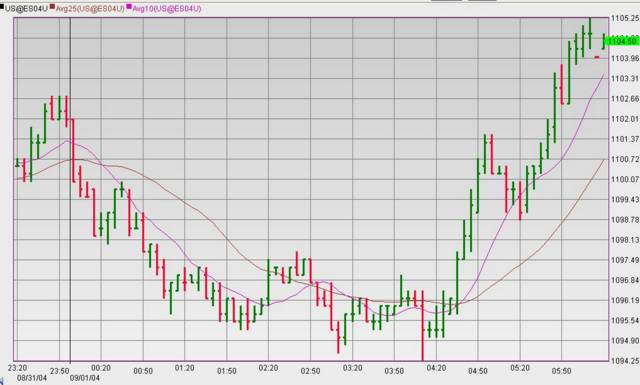
The recent tendency of the market to have these little "rescues" in the afternoon, ought to be very disconcerting. If the entire day's gain is due to a thin-volume short squeeze starting at lunchtime, what happens when the shorts are all squeezed out?

This reinforces the "market is there to inflict the Maximum Pain" hypothesis. Basically, it says that markets don't stop falling until the last bull has been tuned into hamburger patties, and they don't stop rising until the last bear is a rug in front of someone's fireplace. We have had nowhere near enough fear in the markets to indicate a bull washout (and therefore a stable basis for an advance). And bears in the advisory community are rarer than honest analysts.

This sort of price action is faker than Jessica Simpson's blondeness, and until we get past the Republican Bullscheisen Convention, it will be impossible to get a sensible "read" from the markets. My bet is still that we're headed lower, these fake bull runs notwithstanding.

After being down as much as 48 points during the session, the late-day surge helped the Dow Jones Industrial Average gain 51.4 points (0.51%), closing out the day at 10173.92 points; the broader S&P500 Index gained 5.09 points (0.46%), finishing the session at 1104.24.

Over at Times Square, the Nasdaq Composite gained 1.61 points (0.09%), to close at 1838.1, while the Nasdaq100 Index added just 0.74 points (0.05%), ending at 1368.68 points.

The broader stock market measures rose: the NYSE Composite Index gained 39.68 points (0.62%), closing at 6454.22, while the broadest measure of US equities, the Wilshire 5000, gained 53.23 points (0.5%), finishing the session at 10719.15

NYSE Volume was up on yesterday's year-low, but still weak: 1.14 billion shares were traded. Nasdaq Volume was modest, with 1.29 billion shares crossing the tape.

IndexCloseGain(Loss)%
DJIA10173.9251.40.51%
S&P5001104.245.090.46%
Nasdaq Composite1838.11.610.09%
Nasdaq100 Index1368.680.740.05%
NYSE Composite6454.2239.680.62%
Wilshire 500010719.1553.230.5%
NYSE Volume1.14bn--
Nasdaq Volume1.29bn--
US 30-yr yld4.94%-0.05%-1.02%

On the NYSE Advancing Issues outpaced decliners by 2326 to 1006, sor yet another single-day A/D reading over 1200 (the "rally stopping" level); the session fiished to the sound of thundering hooves. That should always make you think; "I can see the wildebeest... where are the crocodiles?"

Meanwhile the raft of bearish commentary in advance of Intel's mid-quarter update made the Nasdaq go squishy; Nasdaq gainers outpaced losers by 1777 to 1237.

NYSE advancing volume outpaced volume in decliners by over 2:1, 765.83 million shares to to 364.74. On the Nasdaq declining volume outpaced volume in advancing issues - but only just - by 292.3 to 264.68 million shares.

On the NYSE, 75 stocks posted new 52-week highs, and 16 hit new 52-week lows. On the Nasdaq 41 stocks hit new 52-week highs, and 47 plumbed 52-week lows.

NYSENasdaq
Advancers23261777
Decliners10061237
Advancing Volume (m)765.83264.68
Declining Volume (m)364.74292.3
New Highs7541
New Lows1647

There was yet another spike in call buying, pushing the single-day Equity Put-Call ratio down to 0.69. Both the Nasdaq100 and the S&P100 (OEX) implied option volatilities fell, which is strange considering the weakness in technology. This reinforces any potential "conspiracy theory" view of the adverse Penguin Parade on INTC: short it yesterday, talk it down, and load up on it today. And if the SEC investigates, it will take them two years to prosecute, and the eventual fine will be less than your annual postage bill. Naaaah...

IndexCloseGain(Loss)%
Equity Call Volume1.71m0.37m27.2%
Equity Put Volume1.18m0.15m14.02%
CBOE Volatility Index15.29-0.15-0.97%
CBOE Nasdaq Market Volatility Index22.92-0.22-0.95%

Bonds rose along the yield curve, with the benchmark US 30-year bond yield shedding 0.051 points to 4.938%. The basic shape of the curve was unchanged, with the entire 2yr-30yr strip posting almost-identical falls in yield.

IndexCloseGain(Loss)%
UST 2Y (yld)2.391-0.05-2.01%
UST 5Y (yld)3.307-0.06-1.87%
UST 10Y (yld)4.121-0.05-1.27%
UST 30Y (yld)4.928-0.05-0.98%

The Banks Index gained 0.7 points (0.71%), finishing the session at 99.16; within the index,

  • the Derivative King - JPMorganChase gained $0.48 (1.23%) to close at $39.58; and
  • Citigroup gained $0.17 (0.37%) to close at $46.58

The Broker-dealer Index gained 0.28 points (0.22%), finishing the session at 124.89; the ticket clippers lined up as follows -

  • Merrill Lynch gained $0.42 (0.83%) to $51.07
  • Morgan Stanley Dean Witter gained $0.13 (0.26%) to $50.73
  • Goldman Sachs gained $0.50 (0.56%) to close at $89.65
  • Lehman Brothers gained $0.72 (0.98%) closing at $73.89

The Philadelphia SOX (Semiconductor) index lost 2.62 points (0.7%), finishing the session at 371.02

  • Triquint lost $0.04 (1.04%) to close at $3.80
  • Micron Technology gained $0.03 (0.26%) to $11.51
  • Intel lost $0.31 (1.44%) to $21.29
  • Altera lost $0.16 (0.84%) at $18.92
  • JDS Uniphase gained $0.04 (1.3%) to close at $3.11

At one stage mid-session, INTC was down over 3%.

Other indices popular with the beta-chasers were mixed, with the

  • Biotech Index up 4.58 points (0.93%), to close at 495.67
  • the Hi-Tech Index down 0.37 points (0.09%), to 421.69

Gold strengthened by $3.10 (1.00%) to $410.50 an ounce, which contributed to the Gold Bugs Index adding 5.26 points (2.6%), finishing the session at 207.39. Silver rose $0.07 to close at $6.79 per ounce. The Gold and Silver Index (XAU) gained 1.94 points (2.09%), to 94.79 points.

IndexCloseGain(Loss)%
Gold410.503.100.76%
Silver6.790.070.98%
PHLX Gold and Silver Index94.791.942.09%
AMEX Gold BUGS Index207.395.262.6%

Oil lost ground, shedding $0.09 per barrel, closing at $42.29 per barrel, however the Oil and Gas Index (XOI) gained 9.14 points (1.45%), finishing the session at 639.45, and the Oil service stocks (OSX) Index gained 2.15 points (2%), finishing the session at 109.83.

Both of the oil indices rose for very interesting reasons: the Pemey company of Mexico (an oil company) announced last night that it had detected a new deposit in th Gulf of Mexico which is so large that Mexico's oil output may rival Saudi Arabia.

The fact that Pemey was honest enough to declare that it doesn't have the "readies" to exploit the new-found reserve means that US oil services companies will be salivating like Homer Simpson in the Land of Chocolate. So Halliburton might be able to move back towards building oil derricks if they can't get no-bid defense department contracts (that is, if Cheney and Bush get removed in November).

There was also a story about Canadian tar sands, which now supply over 1 million barrels a day; this is forecast to rise to 2 million a day by the end of the decade.

This news comes as I am struggling to make sense of some interesting work that insists that oil is abiotic - that is, that it is formed by a geological process that does not involve decayed biological material. If true, it means that oil is constantly being renewed, deep in the earth's mantle. If true (and it is an "if", albeit one that has some credibility for me at the moment), the "peak oil" issue is a furphy and the equilibrium price for oil is about $2 a barrel.

I stress that I am always skeptical about this sort of story (unless the story is being told by Ren Hoek, in which case I believe it utterly and without reservation).

IndexCloseGain(Loss)%
Reuters CRB27810.36%
Crude Oil Light Sweet42.29-0.09-0.21%
AMEX Oil Index639.459.141.45%
Oil Service Index109.832.152%

The US dollar got a bit of a towelling last night, particularly against the Euro and the Swiss Franc, both of which appreciated by over 1% against the greenback. The Australian dollar and the Yen also gained more than half a percent, while the Pound languished relative to the others, gaining just a third of a percent.

IndexCloseGain(Loss)%
US Dollar Index88.96-0.78-0.87%
Euro1.21810.01281.06%
Japanese Yen109.13-0.69-0.63%
Sterling1.80210.00610.34%
Australia Dollar0.70430.00530.76%
Swiss Franc1.2661-0.0129-1.01%

European indices followed the early US movement down... and then closed. won't they feel silly when they open again!

France's benchmark CAC-40 Index lost 42.43 points (1.17%) to 3594.28. The German DAX-30 Index was even more worser, losing 53.64 points (1.4%), finishing the session at 3785.21

The Poms showed a bit more restraint, with the FTSE-100 Index dropping 30.8 points (0.69%), closing at 4459.3.

IndexCloseGain(Loss)%
CAC-403594.28-42.43-1.17%
DAX-303785.21-53.64-1.4%
FTSE-1004459.3-30.8-0.69%

Monday, August 30, 2004

Weak Markets Welcome Flim-Flam Artists to NYC

Note - from June 24th 2009, this blog has migrated from Blogger to a self-hosted version. Click here to go straight there.

Well, our tiny little monkey-like Prime Minister has decided that we must make Hobson's Choice on October 9th. Our "electorate" will waste an hour per person on the day, forced by a draconian system which insists that you must vote even if you strongly prefer "none of the above".

The system confers a false legitimacy on the outcome; it would be hard to claim a mandate if less than half the population bothered to vote (which is what would happen in the event of genuinely free and fair elections - which would include the right to withold your vote entirely).

At least Mark Latham had the good sense to use Australian vernacular ("a conga line of suck-holes") regarding those who backed Bush's rapine of the Cradle of Civlisation. Latham's comments placed politics in its correct context, removing some of the PR varnish and giving us a peek behind the facades. If people had the slightest inkling of how these people behave within the confines of their own party machines, they would lose forever the misconception that politicians are "specialists" at anything. My plan for randomocracy would then be halfway to universal acceptance.

I stress that Latham, being a politician, is automatically classed as a parasite under my "blanket coverage" system: I do not intend to vote for him, for Howard, or in fact for anyone. There - I've said it... I don't vote, even in our "vote or we will fine you" system.

I'll have nothing more to say about domestic politics; I only care about those vermin to the extent that their corruption and meddling buggers up capitalism. We spent trillions of dollars and killed millions of civilians, supposedly to stop the spread of socialism - then our very own politicians ramped up the socialisation of our system to the point where half of all private sector income is paid in taxes.

Speaking of convocations of flim-flam artists. con-men and betrayers of public trust, the Republican National Convention is being held in New York this week. Yet more evidence of the hundreds of millions of dollars tipped down the pan by megalomaniacal lunatics who couldn't earn a living in the private sector (do a web search on Arbusto Oil to see what an MBA can do for you).

I can't believe Bush's advisors were stupid enough to try and exploit the charred and smashed corpses of the victims of 9/11 for political gain. I'm not surprised that they tried, just that it would have taken an almost inhuman lack of modesty or compassion for anybody to suggest it. Then again, these are similar idiots to those who said that the Iraqi people would be strewing rose petals in front of the soldiers who came to liberate their oil, so miscalculation should be expected.

Personal Income and Personal Spending figures for July were released prior to the market open last night. Personal Income rose by little more than a rounding error (0.1%), well short of consensus for a rise of 0.5%. Incomes earned by Americans continue to underperform inflation.

Personal Spending rose 0.8%, exceeding expectations of a 0.7% increase. With both the US government and the US private consumer spending like there is no tomorrow, it should be clear just how little balance-sheet repair has taken place.

The market didn't particularly like the results, but most of last night's action took place well after the release of the numbers.

The Fed did two repurchases; a $9.25 billion 3-day (with $5.99 billion in T-backed) and another $4 billion overnight, all in T-backed. That did absolutely nothing for the market; the repo pump was absolutely non-exstent.

The Dow Jones Industrial Average lost 72.49 points (0.71%), closing out the day at 10122.52 points; the broader S&P500 Index lost 8.62 points (0.78%), finishing the session at 1099.15.

Over at Times Square, the Nasdaq Composite lost 25.6 points (1.37%), to close at 1836.49, while the larger-cap stocks fared marginally worse with the Nasdaq100 Index losing 20.62 points (1.48%), to end at 1367.94 points.

The NYSE Composite Index lost 40.98 points (0.63%), closing at 6414.54, while the broadest measure of US equities, the Wilshire 5000 dropped 89.1 points (0.83%), finishing the session at 10665.92.

NYSE Volume was marginally lower than Friday's (which was the low for the year to date), with 0.85 billion shares crossing the tape. Nasdaq Volume was similarly feeble, with 1 billion shares crossing the tape. I suppose the Convention has driven most New Yorkers to head out early for Labour Day holidays. After all, any sensible person would head for the hills, given the number of half-educated goons with automatic weapons that are now on the streets in the land of the not-really-very-Brave and Home of the formerly-free.

IndexCloseGain(Loss)%
Dow Jones Industrial Average10122.52-72.49-0.71%
S&P500 Index1099.15-8.62-0.78%
Nasdaq Composite1836.49-25.6-1.37%
Nasdaq100 Index1367.94-20.62-1.48%
NYSE Composite6414.54-40.98-0.63%
Wilshire 500010665.92-89.1-0.83%
NYSE Volume0.85bn--
Nasdaq Volume1bn--
US 30-year bond yield4.99%-0.03%-0.58%

On the NYSE declining issues outpaced advancers by 1990 to 1284, and Nasdaq losers outpaced gainers by 2049 to 956.

On the NYSE declining volume vastly dominated the thin trading session, with declining volume exceeding volume in advancing issues by over 4:1 - 673.24 million to to 161.53 million.

There was a similar volume picture on the Nasdaq exchange, with declining volume exceeding volume in advancing issues by a healthy margin of 342.76 million to 82.18 million shares.

50 NYSE stocks posted new 52-week highs, and 12 hit new 52-week lows; on teh Nasdaq there were 28 stocks which posted new 52-week highs, and 37 posting new 52-week lows.

NYSENasdaq
Advancers1284956
Decliners19902049
Advancing Volume (m)161.5382.18
Declining Volume (m)673.24342.76
New Highs5028
New Lows1237

IndexCloseGain(Loss)%
Equity Call Volume1343179-76010-5.36%
Equity Put Volume1038042518375.26%
CBOE Volatility Index15.440.734.96%
CBOE Nasdaq Market Volatility Index23.141.878.79%

Bonds rose across the duration spectrum, with the benchmark US 30-year bond yield shedding 0.029 points to 4.989%.

IndexCloseGain(Loss)%
UST 2Y (yld)2.456-0.02-0.97%
UST 5Y (yld)3.376-0.05-1.34%
UST 10Y (yld)4.178-0.05-1.14%
UST 30Y (yld)4.98-0.04-0.72%
The Banks Index lost 0.51 points (0.52%), finishing the session at 98.46; within the index,
  • the Derivative King - JPMorganChase lost $0.62 (1.56%) to close at $39.10; and
  • Citigroup lost $0.31 (0.66%) to close at $46.41

The Broker-dealer Index lost 2.3 points (1.81%), finishing the session at 124.61; the ticket clippers lined up as follows -

  • Merrill Lynch lost $0.81 (1.57%) to close at $50.65
  • Morgan Stanley Dean Witter lost $0.97 (1.88%) to close at $50.60
  • Goldman Sachs lost $1.33 (1.47%) to close at $89.15
  • Lehman Brothers lost $1.34 (1.8%) to close at $73.17

The Philadelphia SOX (Semiconductor) index lost 8.7 points (2.28%), finishing the session at 373.64

  • Triquint lost $0.19 (4.71%) to close at $3.84
  • Micron Technology lost $0.40 (3.37%) to close at $11.48
  • Intel lost $0.42 (1.91%) to close at $21.60
  • Altera lost $0.22 (1.14%) to close at $19.08
  • JDS Uniphase lost $0.04 (1.29%) to close at $3.07

Other indices popular with the beta-chasers were down, with the

  • Biotech Index lost 15.4 points (3.04%), finishing the session at 491.09
  • the Hi-Tech Index lost 6.94 points (1.62%), finishing the session at 422.06

Gold strengthened by $3.70 (1.00%), but the Gold Bugs Index lost 3.19 points (1.55%), finishing the session at 202.13. Silver rose $0.12 (1.8%) to close at $6.72 per ounce. The Gold and Silver Index (XAU) lost 1.52 points (1.61%), finishing the session at 92.85.

IndexCloseGain(Loss)%
Gold407.43.70.92%
Silver672.1121.82%
PHLX Gold and Silver Index92.85-1.52-1.61%
AMEX Gold BUGS Index202.13-3.19-1.55%

Oil lost ground, shedding $0.73 per barrel, closing at $42.37 per barrel and pressuring the Oil and Gas Index (XOI) which lost 1.38 points (0.22%), finishing the session at 630.31 while the Oil service stocks (OSX) Index dropped 1.42 points (1.3%), to close at 107.68.

IndexCloseGain(Loss)%
Reuters CRB2771.750.64%
Crude Oil Light Sweet42.37-0.73-1.69%
AMEX Oil Index630.31-1.38-0.22%
Oil Service Index107.68-1.42-1.3%
IndexCloseGain(Loss)%
US Dollar Index89.74-0.06-0.07%
Euro1.205400.39%
Japanese Yen109.850.20.18%
Sterling1.79580.010.31%
Australia Dollar0.69940-0.46%
Swiss Franc1.27890-0.27%

France's benchmark CAC-40 Index lost 12.53 points (0.34%), finishing the session at 3636.71, and the German DAX-30 Index was about the same, dropping 12.33 points (0.32%), finishing the session at 3838.85.

In the UK, the FTSE-100 Index gained 36.2 points (0.81%), finishing the session at 4490.1.

IndexCloseGain(Loss)%
CAC-403636.71-12.53-0.34%
DAX-303838.85-12.33-0.32%
FTSE-1004490.136.20.81%

Sunday, August 29, 2004

Money and Growth

Note - from June 24th 2009, this blog has migrated from Blogger to a self-hosted version. Click here to go straight there.

Note: I have edited this post at 5:21 p.m. on August 30th, to correct a reference to MZM - Money At Zero Maturity - which is technically wrong. The Fed controls the money base directly via changes in reserves, but there is no guarantee that a decrease in the growth rate of reserves will result in a decrease in the growth rate of MZM... which can be defined - roughly - as M2, less small-denomination time deposits, plus Institutional Money Market Funds. So while the Fed can affect the money base, the link to the growth of MZM is indirect; it is therefore incorrect to say that the growth rate of MZM must slow. Sorry, but it's been ten years since I did Monetary Economics. - GT

The Mighty Mauombo asked a question that prompted serious consideration; rather than bury it somewhere in the "Comments" I thought I would give it a home of its own.

It concerned the mechanism by which interest rate rises work their way through the economy... here is an attempt to cover the ground. It is necessarly brief, and not comprehensive; it covers primarily first-round effects.

Core Effect: the Money and Debt Markets.

The first effect is that the growth of the money supply must slow (by which I mean "money at zero maturity" - the money base).

That is because the Fed's target funds rate is met by adding to, and draining, reserves through open market operations. If they simply stated "the Fed Funds rate is 1.5%" and did nothing to see to it that the target rate was met, nothing would happen to official interest rates.

A slowing in the growth of MZM (money at zero maturity) will slow the growth of other monetary aggregates by narrowing the spread between borring costs and lending rates; this will (generally) make banks less willing to extend credit at the margin. So the banks will move their "asking rate" upwards at all points of the credit risk spectrum - widening the spread back to - and beyond - its pre-rate-hike level. This is driven partly by a straightforward substitution effect: "risk free" asset prices - government bonds at all points of the yield curve - will fall (yields will rise), making corporate debt less attractive at pre-hike prices.

Usually the increase in risk premia down the credit risk spectrum are "skewed" as well; rates on riskier loans will increase far more than rates on "safer" loans (but generally all points of the credit spectrum will increase by more than the increase in the Fed Funds rate). this is a way for banks to try and offset the fact that higher rates on riskier loans translates into higher default percentages on their books.

The Components of GDP

GDP by expenditure is the following identity:

GDP = C + I + G + (X-M)

where

  • C= Consumption
  • I = Investment
  • G = Government Spending
  • X = Exports
  • M = imports

Investment - I

Usually considered the most sensitive to interest rates, so that's the first port of call.

Higher rates - across the spectrum - means that fewer new projects pass a "net present value" calculation. This is because the required rate of return increases unless the funding mix changes (that is, unless the funding mix tilts towards cash/equity and away from debt).

There is also the crimp in corporate cash flow for those companies who have issued (or swapped into) floating rate debt; this tends to manifest itelf in a rise in interest expense (and an increase in attempts to swap out of floating rates, which moves swap spreads to the detriment of floating-rate debt holders). The requirement to dedicate a larger proportion of cash flow to debt service reduces the capacity to dedicate cash flow to project funding.

This lower rate of gowth in investment demand, means a lower rate of output growth (generally speaking), and slower growth in employment.

Consumption - C

Higher interest costs make additional debt unattractive, and so purchases of durables are affected (since most people buy durables using debt). More important, in the highly-leveraged situation that we find ourselves in, is that existing floating rate debt attracts higher interest charges. These higher interest costs cannot be "substituted way" - except by retiring a portion of the debt completely.

Rising interest costs are similar to rising oil prices, in that they are a highly specific inflation in a segment of the household budget for which there are few substitutes. Effectively, interest charges are part of the "subsistence" budget for households. That means that consumer discretionary spending slows.

Note that this has not touched on the effect of a slowing investment market on employment (and therefore incomes, and therefore expenditure).

Government Spending - G

A lower rate of output growth, coupled with slower growth in discretionary spending (which affects indirect tax collections), means that the rate of growth of tax collections falls.

That is only indirectly linked to government spending - after all, governments can run deficits. but the tendency will be for the budget surplus (if any) to move towards deficit.

To run deficits requires that the government can sell bonds to fund the deficit. Since bond prices fall (generally), and longer-term prices fall farther than short-term prices, the government's tendency is to shorten the duration of their debt issuance, which can be bad if the government is primarily funding longer-term projects (a project-life/funding duration mismatch can be catastrophic).

Funding-duration issues aside, new debt will be issued at a larger discount to face value than old debt - so for a given budget deficit, future budgets will also be saddled with higher interest payments as debt rollovers take place at disadvantageous terms. As such, the effect is to moderate government spending - but only to the extent that government considers the ramifications of its actions on future generations (i.e., after the next election).

Net Exports - (X-M)

There is only one 'first round" effect of a rise in interest rates on the balance of trade, and it's all via the change in the currency.

Higher interest rates encourage an appreciation of the currency via interest arbitrage - some of the money that was previously elsewhere in the world will be drawn to the higher returns offered as a result of the interest rate rise.

Paradoxically, the appreciation will eat into those returns (reducing the foreign-currency equivalent return) to an extent, but the overall effect will usually be an apprecation.

The currency appreciation - again, generally speaking - will cause an expansion in the trade deficit (as it happens, this will only be the case so long as the Robinson-Metzler-Bickerdycke criterion is met... but that is so boring that it should be ignored - involving the elasticities of demand and supply for imports and exports).

The standard idea is that imports become less expensive in domestic currency terms, and exports become less compeettive in foreign currency terms.

There are also some second-round effects due to things like the factor share effect which is in itself affected by import and export price share effects. but generally, a stronger currency will mean a wider trade deficit than would otherwise be the case.

= GDP

On balance, the overall effect of a rise in interest rates is negative for economic growth; that's why they all it "tightening". Note that I have been careful always to speak in terms of slowing of rates of growth rather than rises or falls in GDP aggregates. Tightening monetary policy doesn't "cause" recessions until central banks overtighten, which they always do, after overloosening during downturns.

Time Lags

Monetary policy is always referred to as a "blunt instrument", except by Americans, who think that Greenspan is some sort of consummate central planner (remember the Cold War? Central planning was supposed to be BAD - we spent trillions of tax dollars trying to stop it).

Anyhow, the lags stem from things like product-replacement cycles for durables, and the time taken from planning a project to the time of its implementation.

The lags are important here, because we are now in a world where banks and others have a "truncated horizon".

Corporate officials are remunerated based on quarter-by-quarter numbers, and their remuneration is concentrated in one-sided leveraged bets on the stock price (i.e., options). Furthermore, so long as things "pan out" for two years or so, the aggregate benefits from corporate office are staggering.

As such, growth in the size of the "book" is more important than its composition - by the time a chunk of the debt goes sour, the official responsible for it will have retired with his golden parachute... or moved on.

If you have a long-tailed portfolio being grown with a short-term view, where the size of the book is more important than its composition (and the cost of funds is historically low), you wind up with what I call "Wile E Coyote" behaviour; as official rates start to rise, the credit market simply pedals faster, growing its book (mortgages, especially). Eventually, the book is so bloated that it is actually past the edge of the cliff... still pedalling.

This goes double for "vendor financed" debt, where people get "zero interest until 2006" on everything from electronics to new cars (in the US... there has been no zero rate car finance here to my knowledge).

Usually the vendor-finance loan book is periodically "packaged" as "Collateralised Debt Obligations" (CDOs) and issued as a bond-like instrument; in order to have these "bonds" rated highly, vendors can purchase "default insurance". So you can have a segment of a risky loan book coupled with some default insurance, and thanks to an AA rating, get top prices for them (and of course this counts as "earnings". This is particularly popular for US banks (and GSE's like Fannie Mae and Freddie Mac) for their mortgage books.

The resulting bond includes an instrument (notionally) which shifts default risk to the insurer; insurers are happy because they get to collect all that lovely premium.

Where it comes undone, is the assumption of independence of default risk across the entire CDO - that is, the default insurance premium is calculated as if the risk of default of one loan within the CDO is independent of the risk of any other loan within the batch.

Think for one second about that: in a world where mortgages are increasingly being extended to less and less creditworthy individuals (have you seen the commercials on TV lately?), the "correlation" between defaulters is likely to be much higher than zero. Things that make one sub-prime borrower default are highly likely to make other sub-prime borrowers do likewise: rising uneployment or slower real wage growth are felt overwhelmingly at the lower end of the creditworthiness spectrum.

Folks who run banks don't care a damn about anything that happens to their book, so long as it happens after they leave. The people who take their place can use the previous incumbent as the fall guy, or initiate an "inquiry" which exonerates everybody... behaviour typical of bureaucracies.

We are at the "Wile E Coyote" stage now; people are borrowing floating-rate money to refinance fixed-rte obigations, and are adding to debt on top of that in order to fund the gap between the lifestyle they can afford and the one they think they ought to have. Banks andother financial intermediaries are in no way discouraging this, because so long as everybody is pedalling and inflation is depreciating debt over time, things have a chance of working out just fine.

People are relying on inflation to bail them out - as it bailed out an entire generation of mortgage holders in the 1970s. These are the current 60-somethings who are the genesis of the national mindset that property is a "slam dunk", and who have passed that investment whackery on to their kiddies, who are currently engaged in financial-suicide-by-property-speculation. They don't realise that it was massive inflation and incredibly low fixed mortgage rates that made their parents' homes such a stellar investment. And in the 70s, debt ratios were nowhere near where they are today... we are beyond redemption now, and all that we can do is prepare ourselves for the reckoning.

Friday, August 27, 2004

Oh Magoo, You've done it again...

Note - from June 24th 2009, this blog has migrated from Blogger to a self-hosted version. Click here to go straight there.

Another day, another massive repurchase, and yet ... almost no response from Madame Market.

The Fed pumped $11 bill in an overnight repurchase agreement, with T-backed issuance of $9.726 billion. That ought to have been worth at least five or six points on the "Buy at Midnight for the Repo Pump" strategy. From midnight to 12:15 a.m. (proper, Aussie time) the S&P futures rose three points, so the "broad" outline worked, but nowhere near as well as it ought to have.

Before the market, the US statistical authorities released a slightly-less-fictional account of U.S. GDP. This was a revision to the"advance" estimate, and showed a reduction relative to what they previously tried to convince us was the GDP growth rate. Instead of 3.5% (annualised) they now claim that the actual result was only 2.7% (again, annualised).

Greenspan also waffled about something - it's now unusual for him not to open his idiot yapper somewhere during the session. I don't bother to even read what he says; after all if the guy had any brains he would be earning a fortune in the private sector rather than sucking from the public teat. He was a failure as a private consultant, and he has been a failure as Fed Chairman.

Anyhow - the response to both the data and Greenspan's remarks were a collective "Whoop-de-doo".

The market didn't think much of any of it; it opened weak and then meandered around like a drunk; after lunch there was a bit of a push to a new high for the day, but it all happened on such feeble volume that they may as well have switched the machines off.

The Dow Jones Industrial Average gained 21.6 points (0.21%), closing out the day at 10195.01 points; the broader S&P500 Index gained 2.68 points (0.24%), finishing the session at 1107.77.

In Techland things were even brigher with the Nasdaq Composite gained 9.17 points (0.49%), finishing at 1862.09. Larger-cap techs fared slightly worse with the Nasdaq100 Index adding 4.58 points (0.33%), to end at 1388.56 points.

The broader stock market measures were more bullish than the Dow: NYSE Composite Index gained 15.73 points (0.24%), closing at 6455.52, while the broadest measure of US equities, the Wilshire 5000, posting a gain of 33.39 points (0.31%), finishing the session at 10755.02

NYSE Volume was pitiful, with 0.85 billion shares traded, while Nasdaq Volume was well below average, with 1.01 billion shares crossing the tape.

IndexCloseGain(Loss)%
Dow Jones Industrial Average10195.0121.60.21%
S&P500 Index1107.772.680.24%
Nasdaq Composite1862.099.170.49%
Nasdaq100 Index1388.564.580.33%
NYSE Composite6455.5215.730.24%
Wilshire 500010755.0233.390.31%
NYSE Volume0.85bn--
Nasdaq Volume1.01bn--
US 30-year bond yield5.02%0%-0.06%

On the NYSE advancing issues outpaced decliners by 2235 to 1029, for yet another single-day A/D reading of over 1100. Nasdaq gainers likewise outpaced losers by a wide margin, 1872 to 1109.

NYSE advancing volume outpaced volume in decliners by more than 2:1, 557.15 to 271.74, nd the tilt was even stronger on the Nasdaq with up volume exceeding volume in decliners by 308.81 to 135.9.

61 NYSE stocks posted new 52-week highs, and 12 posted new 52-week lows. On the Nasdaq there were 32 stocks which posted new 52-week highs, and 29 hitting new 52-week lows.

NYSENasdaq
Advancers22351872
Decliners10291109
Advancing Volume (m)557.15308.81
Declining Volume (m)271.74135.9
New Highs6132
New Lows1229
IndexCloseGain(Loss)%
Equity Call Volume (m)1.42-0.28-16.33%
Equity Put Volume (m)0.99-0.20-16.53%
CBOE Volatility Index14.71-0.2-1.34%
CBOE Nasdaq Market Volatility Index21.27-0.33-1.53%

Bonds had a relatively flat day, with the benchmark US 30-year bond yield unchanged at 5.018%. The rest of the yield curve was similarly unchanged (or ans near to unchanged as makes no odds).

IndexCloseGain(Loss)%
UST 2Y (yld)2.4760-0.16%
UST 5Y (yld)3.4220.010.23%
UST 10Y (yld)4.22800.12%
UST 30Y (yld)5.01800%
The Banks Index gained 0.32 points (0.32%), ending the week at 98.97; within the index,
  • the Derivative King - JPMorganChase gained $0.27 (0.68%) to close at $39.72; and
  • Citigroup gained $0.26 (0.56%) to close at $46.72

The Broker-dealer Index lost 0.44 points (0.35%), finishing the session at 126.91; the ticket clippers lined up as follows -

  • Merrill Lynch lost $0.29 (0.56%) to $51.46
  • Morgan Stanley Dean Witter lost $0.42 (0.81%) at $51.57
  • Goldman Sachs lost $0.64 (0.7%) to close at $90.48
  • Lehman Brothers lost $0.89 (1.18%) to close at $74.51

The Philadelphia SOX (Semiconductor) index gained 1.94 points (0.51%), finishing the week at 382.34

  • Triquint gained $0.03 (0.75%) to close the week at $4.03
  • Micron Technology gained $0.05 (0.42%) ending at $11.88
  • Intel gained $0.25 (1.15%) to $22.02
  • Altera gained $0.12 (0.63%) to finish at $19.30
  • JDS Uniphase lost $0.00 (0%) closing at $3.11

Other indices popular with the beta-chasers were up, with the

  • Biotech Index gained 8.45 points (1.7%), ending at 506.49
  • the Hi-Tech Index gained 1.34 points (0.31%), to 429

Gold weakened by $3.80 (-1.00%), however the Gold Bugs Index gained 2.14 points (1.05%), finishing the session at 205.32. Silver lost 9 cents an ounce to close at $6.60 an ounce, however the Gold and Silver Index (XAU) gained 1.07 points (1.15%), finishing the session at 94.37.

IndexCloseGain(Loss)%
Gold403.7-3.8-0.93%
Silver660.1-9-1.35%
PHLX Gold and Silver Index94.371.071.15%
AMEX Gold BUGS Index205.322.141.05%

Oil lost ground slightly, losing just 0.04 cents per barrel (although it had lost 30 cents mid-session). This was a non-event for stocks which are supposed to "depend" on the price of oil... the Oil and Gas Index (XOI) gained 6.61 points (1.06%), finishing the session at 631.69, while the Oil service stocks (OSX) Index gained 0.58 points (0.53%), closing out the week at 109.1.

IndexCloseGain(Loss)%
Reuters CRB275.250.50.18%
Crude Oil Light Sweet43.1-0.04-0.09%
AMEX Oil Index631.696.611.06%
Oil Service Index109.10.580.53%
IndexCloseGain(Loss)%
US Dollar Index89.80.440.49%
Euro1.2013-0.01-0.74%
Yen109.650.060.05%
Sterling1.79-0.01-0.36%
Australia Dollar0.70300%
Swiss Franc1.28250.010.86%

France's benchmark CAC-40 Index gained 19.4 points (0.53%), finishing the session at 3649.24. The German DAX-30 Index gained 18.9 points (0.49%), finishing the session at 3851.18, and in the UK, the FTSE-100 Index gained 36.2 points (0.81%), finishing the session at 4490.1

IndexCloseGain(Loss)%
CAC-403649.2419.40.53%
DAX-303851.1818.90.49%
FTSE-1004490.136.20.81%

Advertising - The Ultimate Miscalculation

Note - from June 24th 2009, this blog has migrated from Blogger to a self-hosted version. Click here to go straight there.

I almost forgot my undertaking to pen a few scattered thoughts on why advertising is a massive shell game.
It stems primarily from two things:
  • that senior managers tend not to be very numerate (particularly those with accounting backgrounds; a little knowledge can often be worse than none at all); amd
  • that senior management likes to be wined, dined, and made feel important by external people who dress real nice (don't we all?).
The first count of the indictment - innumeracy - is the core. Almost every study you see regarding advertising efficacy, is an exercise to attempt to correlate "Ad spend" with Sales. Usually in order to get the "right"result (that advertising generates additional sales), there has to be some distributed lag mechanism whereby "Ad spend" in one time period continues to have effects on sales in subsequent periods. Without that distributed lag mechanism, ad spend can't even be shown to help drive sales (which increase naturally as a result of population growth and inflation anyhow).
Think about that for a minute; that is just to show a net positive effect on sales. Is that the name of the game in business? Sales? Here was me, thinking it was profits.
Consider what happens when a company spends money on advertising. Each dollar spent on ads, is a dollar that would otherwise be profit. It would be free cash, distributable to shareholders.
So in order to "pay its way", a dollar spent on advertising has to generate enough sales so that the net profit of the company is improved.
If a company has net profit margins of, say, 16% (which is pretty high - 10% would be a better number), then a dollar spent on advertising breaks even as an investment only if it yields an additional SIX dollars in sales.
If a company spends a million dollars on advertising, it has to generate an additional 6-10 million in sales - just to have the P&L in the same situation as it would be if they had not bought a single ad.
Oddly, it is only as profit margins rise that advertising becomes a more sensible proposition; if a company has net profit margins of 25%, it needs to generate only an additional $4 in sales per dollar spent on ads.
And some of the "ad spend" is just ludicrous. Has anyone ever thought while in traffic "Hmmm... I must make my next printer a Canon" because of a neon sign over the expressway? Do women actually buy pots of face goo simply because they see a 20-something model in a white coat telling them that the Ponds Institute has "independently proven" the untold benefits of the stuff?
Imagine what would happen if tomorrow if managements woke up and realised that TV advertising reaches a miniscule proportion of viewers (namely, those without remote-control TV's), and that the preponderance of those ignore the ad anyhow. Imagine if they realised that everyone turns over from "Everybody Loves Raymond" the moment it goes to commercial.
The one thing that you can be assured of, is that distributions to shareholders would increase.
The other, is that it would be easier to get a table at decent Sydney restaurants, because former marketing wankers and ad agency folk would be eating Hungry Jacks between shifts as nightfill operators at Coles.
It annoys the crap out of me that a perfectly good medium for information (TV) has turned into a stream of dross which has a primary aim of trying to get people to watch ads - and on the whole, the ads aren't very informative... everyone who drives a Hilux is a weedy little dickhead, people who drive utes are bogans who like AC/DC, and women are utterly obsessed with reducing "the appearance of fine lines" (note: no claim to reduce their existence or number) and/or their hair colour and/or their makeup.
I already knew all of that, and I don't see why products should be more expensive - and returns to shareholders lower - simply to reinforce my extant stereotypes. I don't want a TV/Inernet browser in my fridge door, because I don't spent that much time in the bloody kitchen. but if I did, I would still turn it over when it went to an ad.
And if the advertising for the bajilli0n different "best ever" ab machines pays its way I would be very very surprised; otherwise the name of the company that does all the vending of those things wouldn't change every few years.

On Purpose? Surely Not.

Note - from June 24th 2009, this blog has migrated from Blogger to a self-hosted version. Click here to go straight there.

One thing I'd better make clear up front; I think politicians are vermin. All of them, be they socialist, conservative, 'Third Way", Christian Democrat - whateverrrrr.
Worse than brokerage analysts. Worse than Jessica Reif Cohen and Henry Blodget, combined. Even worse than Abby Joseph Cohen. Worse than the hellspawn offspring of the unholy mating of Larry Kudlow and Abby Cohen.
In the olden times (before 1918), politicians were to the economy as tapeworm in a family pet; they absorbed about 5% of the economy, but on the whole were not genuinely threatening to the long-term well-being of the host.
Sure, every now and then one of them would get particularly uppity and would start a war, into which maelstrom he would send a bunch of working class young men (the people who, by dint of inherent stupidity and lack of education, could be whipped into a martial frenzy). But if you were a chap of middling intellect you could avoid the war - the only price was the scorn of middle aged women... the other group who get all "martial" in time of war, sending white feathers to smart folks who decided to sit out the carnage.
Then something happened; politics became a career.
The entire American Revolution centred around the "unacceptbility" of a taxation regime that took less than 3% of income. THREE per centum. THREE parts per hundred. THREE cents in the dollar.
Remember how we - the West - spent trillions of dollars to fend of the supposedly expansionist scourge of ... gasp... Communism? We created NATO, which scared the patootie out of the Reds... so they built the Warsaw Pact as a defensive measure.
We built more nukes than you need to completely annihilate the planet, and we had already shown that we were preapred to use them on civilians. (And of course, we are the good guys).
We invaded little places like Viet Nam and butchered millions of the poor little buggers, dumped hundreds of tonnes of defoliant on their vegetation, left millions of land mines all over the place to maim subsequent generations... and lost anyway (but we're the good guys, remember).
For what, again?
Because they were prepared to experiment with the ownership of capital. Nothing more.
Imagine if those trillions had been spent on something useful, rather than the geopolitical equivalent of a pissing contest.
The Socialist experiment was doomed (Ludwig von Mises showed that - unequivocally - in the 1920s), but if you genuinely believe in "freedom", ou permit them to give it a shot. After all, it's their capital, n'est-ce pas?
The Russkies had their Revolution - led by, and mostly involving, a bunch of middle-class ideologues who thought they were an intellectual vanguard. Isn't it always the way? Think Lenin/Trotsky... Perle/Wolfowitz.
The Soviets regretted it pretty swiftly - you can tell, because they had to ramp up the propaganda pretty much within a decade.
That shows that the supposed benefits of Socialism were not penetrating the public mind in any tangible way. The broad mass of people were not getting better off.
As I have always said, the moment a system needs to propagandise its achievements to its population, it is doomed. DOOMED, I tells ya.
Why? Simple, silly! If people are being made better off, they already know about it. There's no need to tell them.
That's why political campaigns are never aimed at the upper-middle class. Never, ever, ever. The educated know that they don't need to give a rat's arse about who is in power. Even if they cause a hyperinflation, the upper-middle class make out better than the masses.
Anyway, back to the domino theory. Socialism was supposedly going to thrash its way through the Asian subcontinent, so we were required to go drop burning death from the skies onto their peasantry. That'll learn 'em to go having ideas about installing a different set of fat bastards at the top, we thought.
The central lie of all political systems is that changing the political structure will help most people. Regardless of whether it's a large change - the entire system - or a small one (Howard versus Latham, or Bush/Kerry).
It is taboo to tell folks that most people will be (relatively) poor. Always and everywhere. It has always been that way, and will always (until we overcome scarcity, which I think we will once we stop blowing each other up).
Two hundred odd years ago, the citizens of the American colonies revolted over a tax regime that is trivial by today's standards. Today, taxes (direct and indirect) take HALF of all earned income.
And what does that rapine get us? Not a hell of a lot. Government doesn't give us rising living standards - commerce does. In fact, government is a massive drag on commerce, and perverts its outcomes as a result of the vile nexus between industry and politics.
The way politics is currently played, the political-military-industrial nexus will be the ruin of our civilisation. No question about it. It's almost as if it is being done on purpose.

Thursday, August 26, 2004

Sound and Fury... Where?

Note - from June 24th 2009, this blog has migrated from Blogger to a self-hosted version. Click here to go straight there.

Recall that I write sometimes about the market feeling "slippery" in one direction or the other? Last night was one of those nights when it was not slippery in either direction - except when program trades slammed the thing upwards for seconds at a time.

Last night was never going to result in a decline of any magnitude, despite a worse-than-expected outcome for New Jobless Claims which came in at 343,000, slightly above the 340k expected by the expectorators.

Why no decline? Simple, silly! The Fed did a massive repurchase. Some of it was earmarked to replace an outstanding 14-day repurchase that expired today (or expires tomorrow.. I don't care which).

The Open Market Operations desk did two repurchases. the first - the one which encouraged me to get an early night - was announced just minutes after the new jobless claims data. That one was an $8b, 14-day job, with $7.05 billion in T-backed collateral. It was also issued at a few basis points under the Fed Funds rate.

All of that made me think "Bugger this, I'll get an early night... no decline tonight, and me with a selling bias".

Ticker-junkie that I am, I then thought maybe I would just keep an eye on the thing for a few minutes... see how it was travelling, and watch "The Dream" with my idols, Rampaging Roy Slavin and Haitch-Gee Nelson. (I don't say "haitch" so I have to write it to remind myself).

The "usual" 11:50 (our time) repo number crossed the wirtes, and it were a mind-number, I tells ya. It put the seal of approval on the 40-winks idea.

An $11 billion overnight repo, $9.8b of which was in T-backed, and performed slightly above the Fed Funds rate.

No way. Was the Fed expecting the market to all apart?

When I got up this morning, imagine my surprise; no "flagpole" on the charts, no massive bursts of TICK > 1000, the Dow basically flat and a decline in tech... but overall, a flat boring day. Where was the son et lumiere?

There was the odd high TICK reading - but the entire day's action took place within a 5-point range on the S&P futures.

Those sorts of days are usually terrific for people like me (who try and buy support/oversold and sell resistance/overbought). They are murder for "breakout traders" (people who buy breakouts of the high, and sell breakouts of the low).

Intraday breakout trading is usually the first adventure of the newcomer. It's fun when it works, but that is usually about 20% of the time - because otherwise your stops have to be too loose.

The market is a great place to learn, but the most expensive lesson is that of overtrading; everybody knows the "You got to know when to hold 'em... know when to fold 'em" line from Kenny Rogers' The Gambler. But the two last phrases are equally important - "know when to walk away, know when to run".

The problem with breakout trading is that you never know when to walk away.

Last night there were 2 breakouts of previous intraday highs. Each stalled less than a point above the previous high (the first "printed" exactly one point higher, but anyone who relies on being able to sell the offer is kidding themselves).

And immediately after making those new intraday highs, the market fell away three points. It chopped breakout trades to pieces.

Wanker Watch

Today's "Wanker of the Day" award goes to CSFB's New York wankers, who - desperate for something bullish to help them sell stocks (and collect those precious ticket clippings) -seized upon the "fact" that, on average, stocks go up in the week following the Republican National Convention. What the...?

Now, consider just how feeble that analysis must be. There have only been 32 RNC's since stock market data was collected (1871). When you consider all the confounding factors - war, depression, oil shocks - that supervene over something as trivial as the election cycle of a second-rate country (U.S.A., 1870-1917) or a middling meddler in global affairs (U.S.A., 1920-1944), you can see that once you control for things there is simply no explanatory power left in the data.

Honestly, the wanker at CSFB who thought that up, ought to be run out of town on a rail. Then he ought to go and work in marketing for a shampoo company - that analysis ranks right up there with that mind-clenching slogan for some or other hair product... "the beauty of health".

And now... the numbers.

The Dow Jones Industrial Average lost 8.33 points (0.08%), closing out the day at 10173.41 points; the broader S&P500 Index gained 0.13 points (0.01%), finishing the session at 1105.09.

Over at Times Square, the Nasdaq Composite lost 7.8 points (0.42%), to close at 1852.92, while the larger-cap Nasdaq100 Index dropped 5.19 points (0.37%), to end at 1383.98 points.

The broader stock market measures were more bullish than the Dow: the NYSE Composite Index gained 8.01 points (0.12%), closing at 6439.8, while the broadest measure of US equities, the Wilshire 5000, dropped a scant 2.06 points (0.02%), finishing the session at 10721.63.

NYSE Volume was pretty feeble at 1.02 billion shares, and Nasdaq Volume was also modest, with 1.18 billion shares crossing the tape.

IndexCloseGain(Loss)%
Dow Jones Industrial Average10173.41-8.33-0.08%
S&P500 Index1105.090.130.01%
Nasdaq Composite1852.92-7.8-0.42%
Nasdaq100 Index1383.98-5.19-0.37%
NYSE Composite6439.88.010.12%
Wilshire 500010721.63-2.06-0.02%
NYSE Volume1.02bn--
Nasdaq Volume1.18bn--
US 30-year bond yield5.02%-0.03%-0.57%

Internals and Sentiment

On the NYSE advancing issues beat out decliners by 1817 to 1461, almost in reverse proportion to the Nasdaq where losers trumped gainers by 1769 to 1216.

Advancing volume was also in the ascendant on the NYSE, beating volume in decliners by 553.56 to 446.97. On the Nasdaq declining volume outpaced volume in advancing issues by 357.09 to 165.02 (note: the advance-decline numbers for the Nasdaq look kooky; that's because they're not double counted, unlike part of Nasdaq Total volume).

On the NYSE 59 stocks posted new 52-week highs, and 10 hit new 52-week lows. In tech-land there were 40 stocks which posted new 52-week highs, and 30 hit new 52-week lows on the Nasdaq.

NYSENasdaq
Advancers18171216
Decliners14611769
Advancing Volume (m)553.56165.02
Declining Volume (m)446.97357.09
New Highs5940
New Lows1030

Sentiment indicators are still flashing "Orange Alert". Yesterday's brain-bursting explosion in call buying subsided today (as did the ludicrously high single-day A/D reading), but option volatility indices are still showing profound complacency.

I will do a full sentiment workup over the weekend. Suffice it to say that I remain on a shorting bias, although last night I slept like a baby; with all that Fed repo juice in the tank, I thought "Chance of decline tonight ... Zero. Sleep after painting house yesterday... priceless". God I hate slogans - and not just because they are part of the advertising industry (which is the biggest scam in the history of commerce, relying as it does on the failure of business to distinguish between revenue and profit... I will write something about that later today).

Anyhow... the put-call ratio rose a tad to 0.70 and the A/D line softened considerably on both exchanges.

IndexCloseGain(Loss)%
Equity Call Volume(m)1.7-0.28-14.22%
Equity Put Volume(m)1.18-0.16-11.9%
CBOE Volatility Index14.91-0.07-0.47%
CBOE Nasdaq Market Volatility Index21.60.190.89%

Bonds rose at the long end, with the benchmark US 30-year bond yield shedding 0.029 points to 5.021%.

IndexCloseGain(Loss)%
UST 2Y (yld)2.46-0.088-3.45%
UST 5Y (yld)3.401-0.05-1.45%
UST 10Y (yld)4.211-0.054-1.27%
UST 30Y (yld)5.008-0.038-0.75%

The Banks Index gained 0.11 points (0.11%), finishing the session at 98.65; within the index,

  • the Derivative King - JPMorganChase gained $0.01 (0.03%) to close at $39.45; and
  • Citigroup gained $0.16 (0.35%) to close at $46.46

The Broker-dealer Index gained 0.99 points (0.78%), finishing the session at 127.35; the ticket clippers lined up as follows -

  • Merrill Lynch gained $0.30 (0.58%) to close at $51.75
  • Morgan Stanley Dean Witter gained $1.01 (1.98%) to close at $51.99
  • Goldman Sachs gained $1.09 (1.21%) to close at $91.12
  • Lehman Brothers gained $0.80 (1.07%) to close at $75.40

The Philadelphia SOX (Semiconductor) index lost 3.88 points (1.01%), finishing the session at 380.4

  • Triquint lost $0.08 (1.96%) to close at $4.00
  • Micron Technology lost $0.20 (1.66%) to close at $11.83
  • Intel lost $0.18 (0.82%) to close at $21.77
  • Altera lost $0.38 (1.94%) to close at $19.18
  • JDS Uniphase lost $0.09 (2.81%) to close at $3.11

Other indices popular with the beta-chasers were down, with the

  • Biotech Index lost 3.07 points (0.61%), closing at at 498.04
  • the Hi-Tech Index lost 1.42 points (0.33%), to 427.66

Gold dropped $1.80 (0.44%) to 407.50, and the Gold Bugs Index dropped 2.15 points (1.05%) to close at at 203.18. Silver actually added a nickel or so, finishing at $6.61 per ounce. The Gold and Silver Index (XAU), lost 0.86 points (0.91%) and closed at 93.3.

IndexCloseGain(Loss)%
Gold407.5-1.80-0.44%
Silver6.6910.0610.92%
PHLX Gold and Silver Index93.3-0.86-0.91%
AMEX Gold BUGS Index203.18-2.15-1.05%

Oil lost another 1%, dropping 44 cents a barrel to $43.18. This was no impediment to the Oil and Gas Index (XOI) which gained 4.06 points (0.65%), finishing the session at 625.08, and the Oil service stocks (OSX) Index gained 2 points (1.88%) to close at 108.52.

IndexCloseGain(Loss)%
Reuters CRB274.75-0.05-0.02%
Crude Oil Light Sweet43.180.41-0.94%
AMEX Oil Index625.084.060.65%
Oil Service Index108.5221.88%

Currencies-wise, the US Dollar index softened a little bit, due mostly to gains in the Aussie dollar and the Yen.

IndexCloseGain(Loss)%
US Dollar Index89.36-0.12-0.13%
Euro1.20980.00180.15%
Yen109.64-0.52-0.47%
Sterling1.796400%
Australian Dollar0.7035-0.002-0.28%
Swiss Franc1.2726-0.0007-0.05%

In Europe things were far more interesting than previous sessions: the surrender monkeys had a fit of enthusiasm, with France's benchmark CAC-40 Index stacking on 34.58 points (0.96%), finishing the session at 3629.84.

Not to be outdone, the German DAX-30 Index gained 43.4 points (1.15%), finishing the session at 3832.28, while the Poms joined the mood, lifting the FTSE-100 Index by 42.3 points (0.96%) to close at 4453.9.

IndexCloseGain(Loss)%
CAC-403629.8434.580.96%
DAX-303832.2843.41.15%
FTSE-1004453.942.30.96%

Rothschild's Paradigm...

Note - from June 24th 2009, this blog has migrated from Blogger to a self-hosted version. Click here to go straight there.

One of the Rothschilds once said "I will settle for the middle six-eighths of any move; let others fight over the first and last eighths". Someone else once said that the first and last tenths of any market move was the most expensive.

I have always been impressed by people who can make up a good aphorism; Winston Churchill seemed to have generated an aphorism a day for most of his adult life, which is amazing considering that he was a fat inbred git.

Anyhow, I sat down to do my nightly reading, fortified by a glass and a half of what most non-Krauts would consider a sickly-sweet white.

It's called "Fruitwood". Anybody who has had Dr Loosen's Wehlener Sonnenuhr Riesling Auslese would recognise the taste immediately, but this is a domestic number that gets ignored by wine-wankers who think whites have to be tart, and taste of wood.

But I digress - being slightly "elephant's" (aka slightly "scheisen") will make your mind wander.

I was thinking about aphorisms; Oscar Wilde was good at them... Keynes was pretty good at them. Livy, Ovid, and the rest of the ancient Grecians were not bad either.

But my pick of all the aphorisms I've ever read, is that uttered by the barbarian warlord Brennus as he stood outside the gates of Rome.

Vae Victus (pronounced "Way Wiktiss", I am assured by scholars). Woe Betide the Vanquished.

As I pored over my funny little charts with their interesting squiggles, it leapt out at me and struck me between the eyes.

I've been watching the succession of lower highs and lower lows in the Dow... the unconfirmed higher high in the Dow Transports which generated a bearish non-confirmation per Dow Theory... the various cycles which are timed to have peaked this week... the awful technical picture in the SOX and the Nasdaq. Elliott counts, too.

I don't usually include what I call "Liberace ratios" in my analysis (that is, Fibonacci ratios) but there's a bunch of them as well. And they all point to an absolute WALL in front of themarket just slightly above current levels.

If I am right (and that would mean that all the Fib ratio folks, the Elliott folks, the Dow Theory folks and the valuation folks are right too), then we are about to enter a real steep decline. Something really horrible.

And according to the Investment Company Institute, American 401(k) investors aged 40 and over have more than 55% of their assets in equities.

Although I am a gentle soul, Brennus' words are redolent for me right now; these folks have the chance to get out now and retain what little of their 401(k) they still have in cash. After all, a miniscule nominal yield is far better than what we appear set to generate in equities. If theirretirements are befouled as a result of their silly investment strategy, they have been warned.

US Data Methods - a Brilliant Review

Note - from June 24th 2009, this blog has migrated from Blogger to a self-hosted version. Click here to go straight there.

Those of you who are slightly mystified at my constant carping about the chicanery behind "official" U.S. Statistics, I implore you to read the following:

A Primer on Government Economic Reports

Further to my previous comments about the balderdash involved in saying "it's a Presidential election year, so the markets are likely to rise", a bit of a look at the data shows a couple of things: First, it appears that since 1872, markets are a little under three times as likely to rise during an election year as they are to fall. This contrasts with the "all years" ratio of 1.74 - that is, markets rise, on average, a little under twice as often as they fall.
The problem of sample size rears its head; with so few observations for election years, it turns out that 2.67 is statistically "the same" as 1.74.
No Restriction on PEUpDownRatio
Election Years2492.67
All Years82471.74

When we introduce a constraint to try to account for valuation (at the beginning of the year), the Presidential year ratio doesn't change very much. I've used a value of 15x 12-month trailing earnings as the hurdle, which is being pretty kind, since 15x is close to the average PE over the period. The "who cares what year it is" data also shows no significant change.


Trailing PE > 15UpDownRatio
Election Years933
All Years32201.60
Turns out that with so few data points (only 33 election years, and only 12 which showed even modest overvaluation), there is absolutely no statistical difference between the Presidential-election and non-Presidential-election years.
There have only been 2 Presidential Election years with a PE above 20; 2000 and 1992... as such even trying to perform an anlaysis of what happens in a Presidential election year with a valuation as high as we have now, is fruitless.