Interdum stultus opportuna loquitur...

Thursday, September 30, 2004

See - it's Not Just Me...

Note - from June 24th 2009, this blog has migrated from Blogger to a self-hosted version. Click here to go straight there.

Thanks to "Anonymous" for pointing me to Bill Gross' recent remarks about inflation (and, it turns out, hedonic adjustments - which I have banged on bout for two long years).
Mr Gross is not some lunatic-fringe whackball sitting in Southern New South Wales posting on some marginal Rant blog... he is the big swinger in the bond market, with the largest bond fund on Planet Earth.
Still, that didn't stop him from eventually getting the same idea as the aforementioned whackball in southern NSW...
So folks, if you have a few spare minutes, read Mr Gross' latest Rant (which is colourful and well written).
You will find the stuff about hedonic pricing of computers eerily familiar - it is an echo of what I wrote recently in this little space, and also back in the InvestorWeb days too.
At least now there is someone writing about it that people will take seriously.
What a doofus I am - I forgot to include the link...
Also - please, people who post comments... take a few seconds to let us know who you are - otherwise the whole thing is less personal.

Wednesday, September 29, 2004

CAT Climbs Again... Oil Gyrates

Note - from June 24th 2009, this blog has migrated from Blogger to a self-hosted version. Click here to go straight there.

Federal Reserve Open Market Operations

Another miserly contribution by the central wankers today; the OMO desk did a paltry $3.25 billion, overnight repurchase. Only $2.399 billion was in Treasury-backed collateral, which is less than half of the notional $5 bill required to give the market a decent push.

Not enough repo always equals... no Midnight Moonshot.

Economic Statistics

It was a pretty data-rich day. Mortgage Purchase Applications, Corporate Profits, and GDP were all released before the market opened.

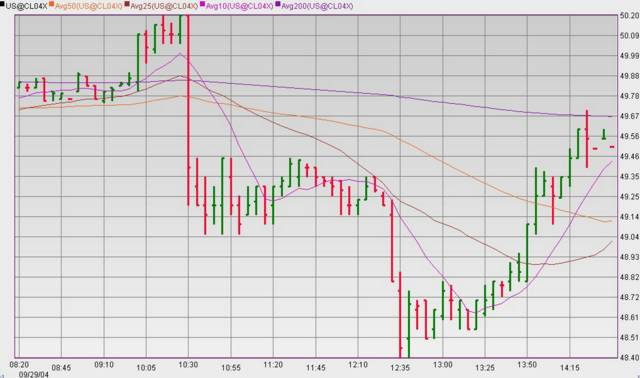
The only number anybody cared about, though, was the Petroleum Status Report released by the Energy Information Administration. That number was released at 10:30 a.m. NY time, and was the excuse for the market to leave behind the morning lows for good (for the session).

The report showed that crude oil inventories rose for the week by 3.4 million barrels. The market had braced itself for another drawdown - recent weeks have seen drawdowns of 7-12 millon barrels.

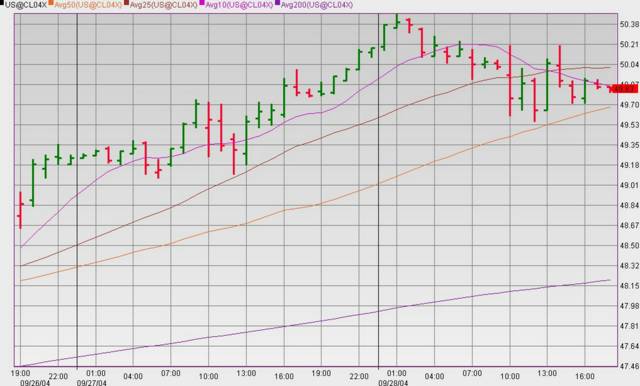
The result of the number was a snap downwards in oil prices by $1 in 5 minutes - and another snap downwards exactly one hour later by another $80c in ten minutes. Another little lesson for the Johnny-Come-Latelies in the oil trading game; when the market gets blindsided by a datapoint, it can be as illiquid as an OTCBB tech stock.

Check out a 5-minute chart of Crude:

Oil's Wild Ride

Oil aside, the rest of the data could be classified as "good but not great".

Mortgage Purchase Applications rose 2.9% for the week, with refinancing applications rising a whopping 7.7%. With mortgage rates slightly softer - down to 5.7% - the "pass the ticking parcel" game continues to be played by people who don't know what they're doing.

Corporate Profits were reported at a staggering 19.5% above last year's level (basis NIPA post-tax corporate operating profits), but only 1.6% from the prior quarter. The whole shebang only amounted to $717 billion (annualised).

GDP grew slightly faster than expected: 3.3% annualised versus a 3.0% cosensus guess. This was the third instalment of the same number (Q2 of 2004). They call this the "Final" number, but in a few years - once revisions are no longer being watched for this number - they will revise away most of it. The GDP deflator - the price component - met consensus expectations with a rise of 3.2%.

Almost all of these numbers were old-ish news, and the futures market gave a very muted reaction to them.

Major US Indices

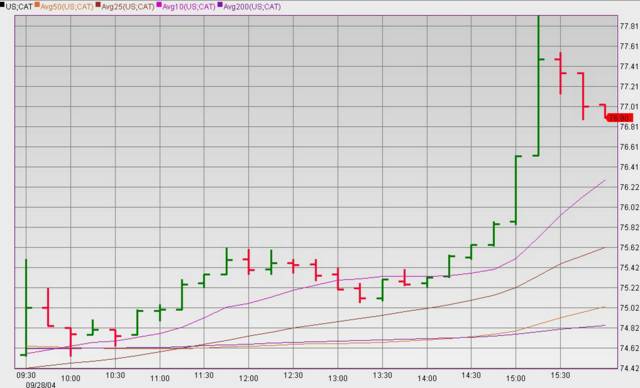
Caterpillar rose another 4.8% today, on the heels of yesterday's rise. Recall that yesterday CAT had offered some mid-session musings about how great business was going to be for the quarter.

Boeing was a drag on teh Dow, losing 2.5% as it was downgraded by some dill somewhere.

All things considered, it was an interesting session - the market is again under the spell of the oil price, and any downtick in the price of crude results in a return to "Happy-Happy-Happy...Joy-Joy-Joy" world...which is fine if you're Stimson J Cat, but not sensible if you're trying to claw your way to a financially-secure retirement.

Speaking of Crude, it recovered manfully from its nuffie-thrashing downdraft immediately after the inventories report... but nobody was watching it.

The DJIA gained 58.84 points (0.58%), closing out the day at 10136.24 points; the broader S&P500 gained 4.74 points (0.43%), finishing the session at 1114.8.

There was a bit of a meltup in Semiconductors which helped the tech market outperform the rest. The Nasdaq Composite gained 24.07 points (1.29%), to close at 1893.94, while the larger-cap stocks fared better with the Nasdaq100 adding 21.16 points (1.52%), to end at 1410.86 points.

The broader stock market measures rose: the NYSE Composite Index gained 17.29 points (0.26%), closing at 6560.68, while the broadest measure of US equities, the Wilshire 5000 posted a gain of 52.47 points (0.48%), finishing the session at 10885.89

NYSE Volume was solid, with 1.41 billion shares crossing the tape, whileNasdaq Volume was slightly above average, with 1.64 billion shares traded.

IndexCloseGain(Loss)%
DJIA10136.2458.840.58%
S&P5001114.84.740.43%
Nasdaq Composite1893.9424.071.29%
Nasdaq1001410.8621.161.52%
NYSE Composite6560.6817.290.26%
Wilshire 500010885.8952.470.48%
NYSE Volume1.41bn--
Nasdaq Volume1.64bn--
US 30-yr yld4.86%0.06%1.25%

Market Breadth & Internals

On the NYSE advancing issues exceeded decliners by 1820 to 1471, yielding a single-day A/D reading of 349; Nasdaq gainers outpaced losers by 2020 to 997. That's a little more measured than either of the previous two days.

NYSE volume was tilted to the stocks that gained for the session, but not overwhelmingly so. Advancing volume scored 841.69 million shares, while registered 546.86 million shares; Nasdaq advancing volume outpaced volume in decliners by 3:1, 663.01 to 220.37 million shares.

133 NYSE-listed stocks rose to new 52-week highs, and 18 posted fresh 52-week lows, while on the Nasdaq there were 71 stocks that hit new 52-week highs, and 41 which fell to fresh 52-week lows.

NYSENasdaq
Advancers18202020
Decliners1471997
Advancing Volume (m)841.69663.01
Declining Volume (m)546.86220.37
New Highs13371
New Lows1841

Market Sentiment

If volatility falls any further, option writers wil be giving calls away. It is really getting silly: if my data is correct then today's close in the VIX is the lowest close for the volatility measure since January 31, 1996.

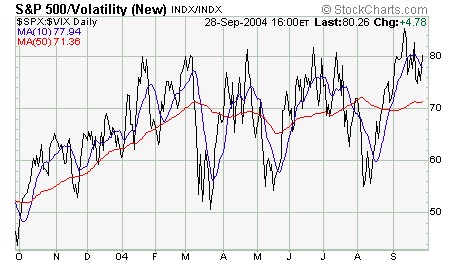
The SPX-VIX ratio is back above 80 - generally a precursor to a marked market decline.

The single-day Equity Put-Call Ratio rose slightly to 0.82 - still in a zone that gives no clues as to likely market direction.

IndexCloseGain(Loss)%
Equity Call Volume1.99m0.07m3.73%
Equity Put Volume1.64m0.09m5.62%
CBOE Volatility Index13.21-0.62-4.48%
CBOE Nasdaq Volatility Index20.67-0.69-3.23%

Bonds

The slightly faster reported GDP numbers gave the bond market something to think about - particularly the price measures. Although these were in line with expectations, it's pretty clear that inflation is now under-reported... and the bond market knows it.

Bonds fell along the yield curve, with the yield on the benchmark US 30-yr bond rising 6.5 basis points to 4.862%.

IndexCloseGain(Loss)%
UST 2Y (yld)2.5850.051.85%
UST 5Y (yld)3.3510.0732.23%
UST 10Y (yld)4.0890.081.97%
UST 30Y (yld)4.8620.0651.36%
The Banks Index gained 0.31 points (0.32%), closing at 97.73; within the index,
  • the Derivative King - JPMorganChase gained $0.30 (0.76%) to close at $39.68; and
  • Citigroup added $0.39 (0.88%) to $44.70

The Broker-dealer Index gained 1.83 points (1.48%), ending the day at 125.68; the ticket clippers lined up as follows -

  • Merrill Lynch lost $0.07 (0.14%) to $50.17
  • Morgan Stanley Dean Witter rose $0.65 (1.33%) to $49.50
  • Goldman Sachs gained $0.22 (0.24%) closing at $93.28
  • Lehman Brothers added $1.57 (2%) to finish at $80.19

The Philadelphia SOX (Semiconductor) index gained 6.93 points (1.85%), finishing the session at 380.62

  • Triquint gained $0.06 (1.61%) to close at $3.79
  • Micron Technology lost $0.04 (0.33%) to close at $12.10
  • Intel added $0.39 (1.98%) to close at $20.07
  • Altera rose $0.37 (1.96%) to close at $19.29
  • JDS Uniphase gained $0.07 (2.15%) to close at $3.32

Gold & Silver

[Commentary]

Gold strengthened by $0.90 (0.22%) to $412.90. The Gold Bugs Index was almost unmoved by the rise in the metal, rising just 0.09 points (0.04%) to close at 223.98 points.

Silver continued a strong recent rally, adding $0.08 (1.23%) to $6.68 per ounce.

The Gold and Silver Index (XAU) shed 0.39 points (0.39%), finishing the session at 99.39 points.

IndexCloseGain(Loss)%
Gold412.90.90.22%
Silver6.6750.0811.23%
PHLX Gold and Silver Index99.39-0.39-0.39%
AMEX Gold BUGS Index223.980.090.04%

Oil

After some real gyrations during the session, Oil lost ground, shedding $0.33 per barrel, closing at $49.52 per barrel.

The Oil and Gas Index (XOI) dropped 7.51 points (1.07%)to 694.58 while the Oil service stocks (OSX) Index lost 1.84 points (1.51%), finishing the session at 120.09 points.

IndexCloseGain(Loss)%
Reuters CRB28310.35%
Crude Oil Light Sweet49.52-0.33-0.66%
AMEX Oil Index694.58-7.51-1.07%
Oil Service Index120.09-1.84-1.51%

Currencies

[Commentary]

IndexCloseGain(Loss)%
US Dollar Index88.290.020.02%
Euro1.2330.00140.11%
Yen110.85-0.46-0.41%
Sterling1.7992-0.0134-0.74%
Australian Dollar0.7167-0.0010-0.11%
Swiss Franc1.2585-0.0015-0.12%

European Markets

France's benchmark CAC-40 Index gained 15.2 points (0.41%), finishing the session at 3682.67; the German DAX-30 Index added 38.09 points (0.98%), ending the day at 3920.36; and in the UK, the FTSE-100 Index edged ahead 20.8 points (0.46%) to close at 4588.1

IndexCloseGain(Loss)%
CAC-403682.6715.20.41%
DAX-303920.3638.090.98%
FTSE-1004588.120.80.46%

CAT Lets Loose

Note - from June 24th 2009, this blog has migrated from Blogger to a self-hosted version. Click here to go straight there.

MR HOWARD, YOU COWARD - GO ON ROVE LIVE.

Obviously now Howard can't go on Rove Live, because he would be seen to be capitulating to pressure.

Being a typical short man, he views an concessional behaviour as weakness - which actually makes him a very weak personality... I'm talking about Howard, not Rove.

I hope 20-somethings can see this weakness of character - they will generally vote for "progressives" anyway, but it is instructive to see a weak, small-hearted man ducking what could have been a very soft-soap interview.

Federal Reserve Open Market Operations

The Fed had nothing to do with the jamjob that happened last night - contrary to my expectations in yesterday's ramblings, there was no big repurchase... just a bounce generated by the ludicrously lopsided advance-decline and volume numbers from yesterday.

The Fed performed a single 3-day repurchase for a total of $3.25 billion; only 0.583 billion was in Treasury-backed (indicating that the Fed knew that the stock market would look after itself). The rest was in mortgage backed collateral.

Economic Statistics

The only economic number released last night was the Conference Board survey of Consumer Confidence. The number as released at midnight our time, and was softer than expected.

The Current Conditions Index within the survey fell quite hard, which was the principal contributor to an index reading of 96.8 (as compared with a consensus guess of 100). The Future Conditions Index actually edged up but the increase was smaller than a rounding error.

Major US Indices

The little spurt last night was mostly generated by Caterpillar (CAT), who for some reason decided to release a bullish earnings update during the session. The comments by management were extraordinarily upbeat - talk of "unprecedented" growth in sales, with earnings up as much as 80%.

Caterpillar's Moonshot

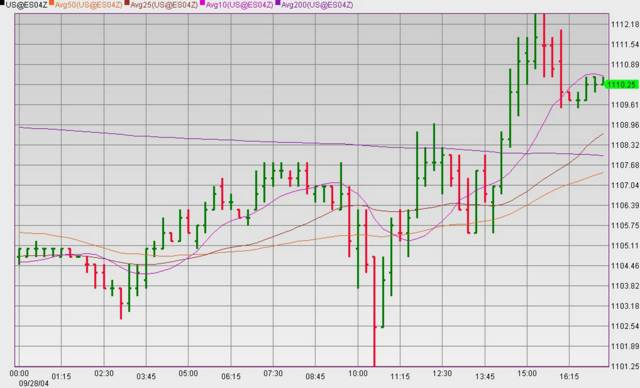
It's pretty clear from the chart below that the broader market was already in 'bounce mode" when CAT let it's announcement out of the bag (boom boom). Note that the time stamps on the chart below are Chicago time, so the "CAT news" spike happens at 2 p.m. CT rather than 3 p.m. ET... but it's the same time.

S&P Futures Intraday

The S&P futures tested 1101.25 over an hour after the release of the bad confidence data, but the bears couldn't retain control and drive the index down below 1100. That's to be expected - it took two days to for the Dow 10200 and 3 days to breach 10100 on the way down. Even without the CAT news last night, things were still set up for a bounce back above Dow 10000; the CAT news just gave the afternoon more ofa "short squeeze" flavour.

The DJIA regained the "five figure" level, adding 88.86 points (0.89%), closing out the day at 10077.4 points; the broader S&P500 gained 6.54 points (0.59%), finishing the session at 1110.06.

Over at Times Square, the Nasdaq Composite gained 9.99 points (0.54%), to close at 1869.87, while the larger-cap stocks fared worsewith the Nasdaq100 adding 4.15 points (0.3%), to end at 1389.7 points.

The broader stock market measures lagged the blue-chip Dow: NYSE Composite Index gained 47.02 points (0.72%), closing at 6543.39, while the broadest measure of US equities, the Wilshire 5000 posted a gain of 68.62 points (0.64%), finishing the session at 10833.42

NYSE Volume was pretty solid, with 1.4 billion shares traded, while Nasdaq Volume was about average, with 1.55 billion shares changing hands.

IndexCloseGain(Loss)%
DJIA10077.488.860.89%
S&P5001110.066.540.59%
Nasdaq Composite1869.879.990.54%
Nasdaq1001389.74.150.3%
NYSE Composite6543.3947.020.72%
Wilshire 500010833.4268.620.64%
NYSE Volume1.4bn--
Nasdaq Volume1.55bn--
US 30-yr yld4.8%0.03%0.61%

Market Breadth & Internals

MArket internals are getting really very head-spin-ish. One day eveything's a diamond, the next day everything's a stone. Last night was as ludicrously tilted to the gainers as the previous night was to losers. That indicates that short-term "hot" money - hedge funds - are the drivers in this market.

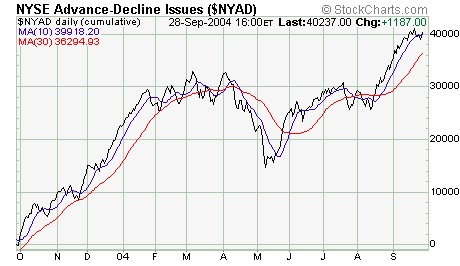
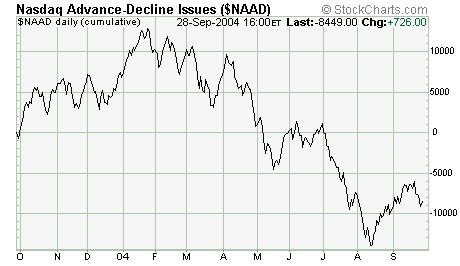
On the NYSE advancing issues outpaced decliners by 2269 to 1026 for a single-day A/D reading of 1243; Nasdaq gainers outpaced losers by 1908 to 1148. The Cumulative A/D lines for the two major exchanges tell a story of a divergence which must resolve itself in the direction dictated by valuation - that is, the next major swing will be to the downside.

NYSE Cumulative A/D Making New Highs

Nasdaq Cumulative A/D Not Nearly as Strong

NYSE advancing volume outpaced volume in decliners by over 2:1, with 960.04 million shares traded in stocks that gained for the session as compared with 418.69 million shares in losers; Nasdaq volume was more evenly divided with advancing volume shading volume in decliners by 452.77 to 394.51 million shares.

154 NYSE-listed stocks rose to new 52-week highs, and 35 posted fresh 52-week lows, while on the Nasdaq there were 55 stocks that hit new 52-week highs, and 62 which fell to fresh 52-week lows

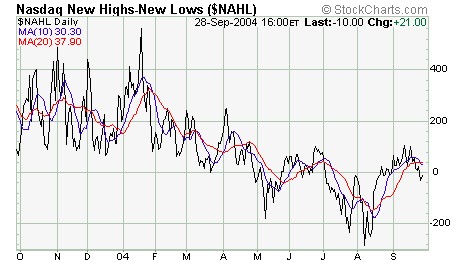
Of particular interest is the shape of the chart of the New Highs - Ne Lows for the Nasdaq; it has been unimpressive all year and has never really given any indication that a "washout" was in progress.

More New Lows than Highs on Nasdaq

NYSENasdaq
Advancers22691908
Decliners10261148
Advancing Volume (m)960.04452.77
Declining Volume (m)418.69394.51
New Highs15455
New Lows3562

Market Sentiment

Sentiment indicators continue to tell a story of a market that nobody thinks will fall.

It's all very well for pundits to crap on about Presidential Cycles - a "no brainer" since you have to have no brains to believe it. There's also the shorter-term "Buy Rosh Hashana, Sell Yom Kippur" mantra that always accompanies the Days of Awe. But eventually the tide goes out - and as Warren Buffet once famously said, that's when you find out who's swimming naked.

The VIX is mind-bogglingly low - both in absolute terms and relative to the level of the S&P500. The Put-Call ratio is falling - albeit not to levels that are particularly interesting.

It is almost as if the market is sending a strong message that it will not go anywhere until after the election; that means it does not want to go up after the election - otherwise that would be the path of least resistance at the moment. As we saw in 2000, a Repubican victory is not necessarily a harbinger of market delights; we are in a generational bear market and anyone who tells you otherwise is trying to sell you something.

SPX-VIX Ratio at Crash Levels

IndexCloseGain(Loss)%
Equity Call Volume1.92m0.15m8.49%
Equity Put Volume1.55m0.11m7.36%
CBOE Volatility Index13.83-0.79-5.4%
CBOE Nasdaq Volatility Index21.36-0.56-2.55%

Bonds

Despite the rather downbeat confidence numbers, bonds fell at the long end of the maturity spectrum, with the yield on the benchmark US 30-yr bond rising 2.9 basis points to 4.801%. the 3-month to 5-year strip was a different story, with yields falling up to 5 basis points.

IndexCloseGain(Loss)%
UST 2Y (yld)2.504-0.04-1.49%
UST 5Y (yld)3.263-0.016-0.49%
UST 10Y (yld)4.0020.010.18%
UST 30Y (yld)4.8010.0290.4%
The Banks Index gained 0.67 points (0.69%), finishing the session at 97.42; within the index,
  • the Derivative King - JPMorganChase gained $0.25 (0.64%) to $39.38; and
  • Citigroup gained $0.70 (1.61%) to close at $44.31

The Broker-dealer Index gained 0.66 points (0.54%), finishing the session at 123.85; the ticket clippers lined up as follows -

  • Merrill Lynch gained $0.36 (0.72%) to $50.24
  • Morgan Stanley Dean Witter gained $0.08 (0.16%) closing at $48.85
  • Goldman Sachs gained $0.31 (0.33%) to close at $93.06
  • Lehman Brothers gained $0.44 (0.56%) to $78.62

The Philadelphia SOX (Semiconductor) index lost 3.27 points (0.87%), finishing the session at 373.69

  • Triquint lost $0.02 (0.53%) to $3.73
  • Micron Technology lost $0.18 (1.46%) to close at $12.14
  • Intel lost $0.24 (1.2%) finishing at $19.68
  • Altera lost $0.09 (0.47%) to $18.92
  • JDS Uniphase lost $0.03 (0.91%) closing at $3.25

Gold & Silver

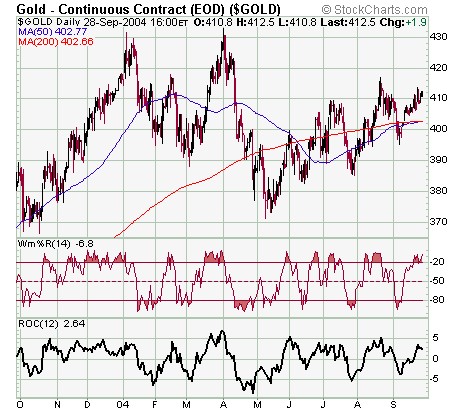
Gold's chart is at a pretty interesting juncture; it is overbought - although not desperately so - but has failed to exceed its previous swing high.

Now my "Elliotteering" ranks with only the enthusiastic amateurs, but what I see on the chart below is a big ol' fashioned double top - and after that a series of waves that have resulted in a lower high. I am still of the view that the mettle of Gold investors and speculators will be tested one more time before a rise to new historic highs. this will involve a downdraught that will take Gold back below $350 and possibly even below $300 - just to screw latecomers. (Of course is you bought gold when I said to - January 30th, 2002 - you could ride that downdraft and giggle all the way).

Gold - Setting Up a Failure?

For today however, Gold strengthened by $3.50 (0.86%) to $412 an ounce, which contributed to the Gold Bugs Index adding 7.87 points (3.64%) to 223.89 points.

Silver rose $0.06 (0.96%) to close at $6.59 per ounce. The Gold and Silver Index (XAU) gained 3.07 points (3.17%), finishing the session at 99.78

IndexCloseGain(Loss)%
Gold4123.50.86%
Silver6.5940.0630.96%
PHLX Gold and Silver Index99.783.073.17%
AMEX Gold BUGS Index223.897.873.64%

Oil

Oil tops $50

Oil hit $50 as I was typing last night, and rose as high as $50.47 on ACCESS last night. It softened late in the session, and for the session rose by just $0.08 per barrel, closing at $49.90 per barrel. The Oil and Gas Index (XOI) gained 11.17 points (1.62%) to 702.09 while the Oil service stocks (OSX) Index gained 2.12 points (1.77%), finishing the session at 121.93.

IndexCloseGain(Loss)%
Reuters CRB2820.250.09%
Crude Oil Light Sweet49.90.080.16%
AMEX Oil Index702.0911.171.62%
Oil Service Index121.932.121.77%

Currencies

The Australian dollar was again in the van last night, rising 0.6% against a broadly weaker US dollar. Yet again, Yen support - probably by the Bank of Japan - is the only source of succour for a US dolalr that is trying to hold up under the burden of massive external imbalances and fiscal mismanagement of monumental proportions.

IndexCloseGain(Loss)%
US Dollar Index88.27-0.21-0.24%
Euro1.23230.00260.21%
Yen111.350.110.1%
Sterling1.81290.00390.22%
Australian Dollar0.71770.00430.6%
Swiss Franc1.2586-0.0021-0.17%

European Markets

Does anybody care what happened in Europe? I don't - although I am genuinely Europhile (my Europhilian is for culture and stuff rather than their economic dynamism).

Basically Europe gets head-faked or drop-faked by the US market all the time, except for the one day a month when Euro-zone news actualyl drives the market.

France's benchmark CAC-40 Index gained 10.54 points (0.29%), finishing the session at 3667.47; the German DAX-30 Index gained 7.9 points (0.2%), finishing the session at 3882.2; and in the UK, the FTSE-100 Index gained 26.1 points (0.57%), finishing the session at 4567.3

IndexCloseGain(Loss)%
CAC-403667.4710.540.29%
DAX-303882.277.90.2%
FTSE-1004567.326.10.57%

Tuesday, September 28, 2004

Not Thinking, Musing

Note - from June 24th 2009, this blog has migrated from Blogger to a self-hosted version. Click here to go straight there.

A couple of questions were raised this week - the answers are moderately convoluted, so I'll have a crack at them, but these will be more in the "stream of consciousness" paradigm rather than a tightly reasoned explanation.
The first query concerned the property market (which I take to mean residential property in a major capital city; regional property markets are vcery much a creature unto themselves). The other was about my comments on the "Free Trade Agreement" with the United States. I'll get to the FTA when I've gotten good and liquored up so I an really get a rant on... for now I'll have a crack at the...
Property Market.
I've been bearish on property for a couple of years now - so far it's been the wrong view to have if you're the sort of person who likes to speculate in highly illiquid assets using massive leverage. I'm not that sort of person, so holding a bearish property view hasn't hurt me at all.
The property market in major urban centres in Australia (anyplace bigger than Albury) continues to defy investment logic; most of this problem is concentrated in major metropolitan areas, and in particular Sydney and Melbourne.
At present the average gross rental yield is only slightly higher than 10-year bond yields. That leaves precious little room for the maintenance and ongoing expenses associated with property investment.
Debt service as a proportion of income has seldom been higher, and yet interest rates have seldom been lower.
In other words, everyone expects to make their gains via capital appreciation; it's the "Greater Fool Theory" from the stock market, but with a much higher degree of leverage.
The "heady" days of buying apartments off the plan have passed, much to the chagrin of those who have been absolutely roasted by doing so. Likewise, we are getting past the ludicrous proposition that you can slap some paint on a structurally-unsound property, scatter some cushions and rented furniture around, and add $40k to the price: I said a couple of years back that when there are two TV shows about that sort of malarkey, we are near a top in the property market. There ended up being three such shows, and now there are only two again... and the auction results recently have been pretty miserable (but of course when there is only one vendor bid on auction day, we are told by the Lovely Joanna that someone buys it after the camera stopped rolling... pshaw).
There are a couple of historical reasons why people hear from their parents that "you can't go wrong with bricks and mortar". This has affected the investment expectaitons of a huge crop of 30-somethings who don't see property investment for wha it is - as I said above it is a massively leveraged bet on a highly illiquid asset.
The "property is a no-brainer" hypothesis is really a no-brainer... people who believe it have no brains. It is a fallacy based on a historically-anomalous period - the huge burst of inflation and expansion of monetary aggregates in the 1970s.
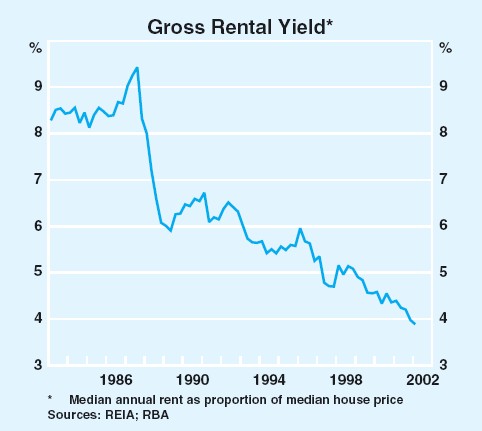
The result has biased investment decisions in favour of property for almost a generation. This has led to the situation in which the "normal" gross yield (income only) on property barely exceeds bond yields - something in the 5-7% range is considered better-than-acceptable, and the latest data that I could find showed something considerably lower than that (see below for a chart of just how far yields have fallen- it only covers until 2002). Bear in mind that the rental yield on property is similar to the PE on stocks (it is closer - conceptually - to the dividend yield on stocks, but ignores maintenance, rates and other upkeep costs).
Would you buy a stock with a PE of 25, when every man and his dog were tripping over themselves to buy the same stock - on 90% margin?
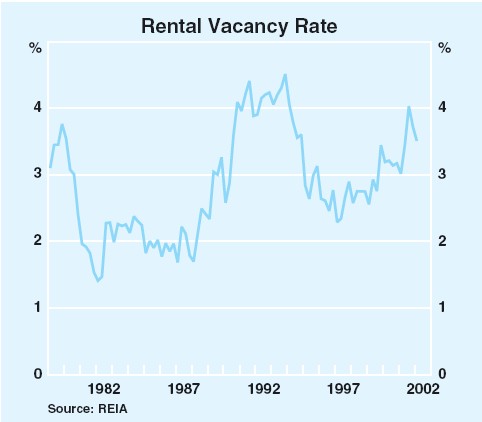
Bear in mind also, that that gross rental yield is not adjsuted for "idle periods". The "expectation" of the gross rental yield, is equal to the occupancy rate times the gross rental yield. Occupancy rates are declining (i.e., vacancy rates are increasing - see below).
Think for a minute as to why the current crop of 60-somethings - who view stockmarket investment as highly risky - might think highly of the property market.
When they bought their first properties - usually the house in which they intended to raise a family - they were able to finance the purchase with a fixed 25-year mortgage at rates at or below 5%. That was in the mid-to-late 60's; employment was relatively plentiful and debt service ratios were manageable.
During the 1970s there was a period of inflation such as the world had not seen before (except in highly concentrated situations, e.g., Germany during the Weimar Republic, France during John Law). Price inflation topped 10% on average over the 1970's - and assets inflated faster than prices.
So by the end of the 1970s the current crop of 60-somethings - who were barely 40 at this stage - were sitting on an asset that had doubled or tripled since they bought it. Since most people don't think hard enough about real returns, they thought they had struck it rich; also, because wages tend to rise with prices, the fixed mortgage payments became trivial in relation to inflation-augmented wages.
So the primary experience was of rising asset prices with an attendant debt obligation that became much more manageable with the passing of relatively few years.
If you're convinced that you've found a money machine with attributes like that, it will appear to make sense to go and get hold of as many copies of the machine as you can afford - hence the "second property" craze which continues to this day.
Second-property mortgages came into the "average" property investor's sights in the 80's; interest rates were high, but "everybody" knew that over time, inflation made the fixed repayments shrink relative to rental income from the property (which grew with inflation).
There was also the discovery of "negative gearing", and the capital-gains tax benefits from property ownership.
Add to that a 22-year bull market in bonds and the opportunity to refinance second-property mortgages at the decreasing rates which resulted, and you have a recipe for a slow-simmering mania.
The end-game for these sorts of events is never pretty.
There were also people who financed property investment when interest rates were much, much higher; of the order of 18% for a standard mortgage. The terrific thing for those people was that they purchased when prices were low (because of the damping effect of high interest rates on demand). Still, enough people found themselves in a "negative equity" situation at the end of the 1980's to have cause a real problem for banks; many of them behaved irrationally - holding on to an asset that was worth less than they owed on it, hoping that time and inflation would get them out of the hole.
History shows us that this is what happened; a lot of people with negative equity were "saved" by the subseuqent bull market in bonds and the ability to refinance mortgages with more advatageous interest rates.
That sort of logic - "I was showing a big loss, but now I'm showing a profit, so I'm a genius" - reminds me of dumb stock traders, who will buy a share at $1, see it fall to $0.05, then spruik their "win" when it claws its way back to $1.01 (if it ever does). Far better to ditch the thing at 80c (or when it approaches a sensible measure of "fair value") and buy it back lower. I know... that's hard to do with a house considering the illiquid nature of the market, but it's still sensible to watch valuation ratios for property and exit the market when they get too rich.
The present landscape sees the entire property market being buoyed by low interest rates. Because rates are so low and competition in mortgage markets is so aggressive, mortgage finance is being extended on some ludicrous terms. We have all seen the ads that tell us that we can live in such-and-so a new development with no money down ... and the developer will even give us back the $7 thousand government homebuyers grant.
The laxity of lending standards means that there is a larger pool of "cashed up" (really, they're debted up) potential buyers. People who are earning roughly average weekly earnings (which is now $50k for a man working full-time) are out borrowing half a bar ($500k) for a 3 bedroom terrace. And people give themselves a little cheer when they're the highest bidder on a property, even if they exceed their budget.
I've heard some people (property investors, HIA people and "Real Estate Institute" types, mostly) who tout the fact that inner-city housing is in naturally-restricted supply and so with growing demand prices will naturally rise.
Where is this "demographic shift" coming from, in a country with slowing population growth? People moving from the country to the city don't have the budget to drive property price up - and besides the urbanisation of this country has been happening at a more-or-less steady pace since Federation.
It's not caused by us breeding faster, either - age cohorts are smaller as we move away from the Baby Boomers.
It's not the "tidal wave of woggoes"... Migrants generally arrive without much capital - and besides, without them population would be contracting.
So the "migration to the resticted inner-city" hypothesis is another "no brainer"... believe it, and you've got no brain.
The thing which id driving real estate prices - still - is just a shift in the tolerance for debt and leverage. It's all driven by notions that have their roots in a lucky coincidence - widespread new access to mortgage markets in the 60's couple with a massive burst of inflation in the 70's.

Monday, September 27, 2004

As Mondays Go, Pretty Ordinary

Note - from June 24th 2009, this blog has migrated from Blogger to a self-hosted version. Click here to go straight there.

Federal Reserve Open Market Operations

The Fed's OMO desk performed a $5.25 billion overnight repurchase, with just $3.25 billion in Treasury-backed collateral.

Now $3.25 billion might be enough for most people to pay off the credit card and have a few coins left in the pocket for a good session "on the gas", but it's not enough to generate a Midnight Moonshot. Plus, when the oil market is making new highs, perhaps da Boyz have better things to do than to goose the equity markets.

Also, there were a couple of Treasury auctions - for 3-month and 6-month paper. The "internals" of those auctions were not very good.

The 3-month auction was for the "usual" $19 bill for the week (in 2000, they issued less than that per quarter). The auction had a bid-to-cover ratio of 1.96, and the auction was cleared at 1.71%. That's the first time in a year that the bid-to-cover ratio has been below 2 at the same time as the auction's resultant 3-month bill rate rose.

The same happened in the $17 billion 6-month auction; the bid-to-cover ratio was even weaker at 1.72 and the high bid was 1.95% - a rise of 8 basis points in a week.

Economic Statistics

The only economic data released last night was New Home Sales, which exceeded expectations by a wide margin. The number came in at 1.184 million units, well above the 1.15 million consensus guess, and close to the top of the 1.012-1.25 million range of guesses.

The New Home Sales numbers were released at midnight our time, and the market seemed not to notice.

Major US Indices

Last night was all about maintaining a 5-figure Dow - and it failed. (A second "save target" - 1100 on the S&P - held easily).

It - the Dow 10k Project - failed pretty dismally, considering the effort that went in, although da Boyz were somewhat constrained by the lack of repurchase funds to give the market a good early push. Hell, you don't expect them to use their own money, do you?

There was one attempt to get some short-covering happening - as usual, initiated during the lunch period - but by the end of the day the cash markets closed at or near their session lows.

The lunchtime push took the market to its session highs, with the S&P500 futures touching 1109; the high was set within a minute or so of 1 p.m. NY time, which was the time that the data regarding the Treasury note auctions was released. From there, the markets softened considerably, but someone took advantage of the post-cash-session to goose the futures by a full 2 points; the result is that the futures clsoed at a 2-point premium to the cash indices... Why?

For the session, the DJIA lost 58.7 points (0.58%), closing at 9988.54 points; the broader S&P500 lost 6.59 points (0.59%), finishing the session at 1103.52.

At Times Square, the Nasdaq Composite fared considerably worse than its bluer-chip counterparts, losing 19.6 points (1.04%), to close at 1859.88. Larger-cap stocks techs dropped a little less than smaller ones, with the Nasdaq100 losing 13.5 points (0.96%), to end at 1385.55 points.

Broader stock market measures fell: the NYSE Composite Index lost 35 points (0.54%), closing at 6496.37, while the broadest measure of US equities, the Wilshire 5000, posted a loss of 73.42 points (0.68%), finishing the session at 10764.88.

NYSE Volume was about average, with 1.26 billion shares traded, whileNasdaq Volume was moderate, with 1.32 billion shares crossing the tape.

IndexCloseGain(Loss)%
DJIA9988.54-58.7-0.58%
S&P5001103.52-6.59-0.59%
Nasdaq Composite1859.88-19.6-1.04%
Nasdaq1001385.55-13.5-0.96%
NYSE Composite6496.37-35-0.54%
Wilshire 500010764.88-73.42-0.68%
NYSE Volume1.26bn--
Nasdaq Volume1.32bn--
US 30-yr yld4.77%-0.03%-0.58%

Market Breadth & Internals

On the NYSE declining issues exceeded advancers by 2113 to 1191, for a single-day A/D reading of -922; the Nasdaq advance-decline stats were horrendous, with losers outpaced gainers by 2198 to 862.

That's a little too "decline-y" for my liking - and makes me expect a big repurchase and a good moonshot tomorrow.

NYSE declining volume was dominant by a factor of 3:1 with 940.18 million shares traded in declining issues versus just 310.8 million shares in advancing issues. On the Nasdaq it was even more tilted at over 4:1 in decliners - declining volume at 574.45 million shares trounced volume in advancing issues of just 140.68 million shares.

101 NYSE-listed stocks rose to new 52-week highs, and 47 posted fresh 52-week lows, while on the Nasdaq there were 40 stocks that hit new 52-week highs, and 66 which fell to fresh 52-week lows

NYSENasdaq
Advancers1191862
Decliners21132198
Advancing Volume (m)310.8140.68
Declining Volume (m)940.18574.45
New Highs10140
New Lows4766

Market Sentiment

Despite the fairly bearish market internals, there was actually a welter of call buying, pushing the put-call ratio down to 0.82 and taking it back towards a neutral reading.

Voaltility indices rose slightly, but it's still pretty obvious that call sellers aren't demanding high option premia - that is, they are just trying to sell as much premium as possible, with less regard for the premium peroption. BEARISH.

IndexCloseGain(Loss)%
Equity Call Volume1.77m0.19m11.82%
Equity Put Volume1.45m0.09m6.42%
CBOE Volatility Index14.620.342.38%
CBOE Nasdaq Volatility Index21.920.823.89%

Bonds

Bonds appear to be benefciaries of money seeking "safety" - when the debt issuance statistics indicate that the US bond market is anything but safe.

Bonds rose in suchrony along the curve, with the benchmark US 30-yr yld shedding 3.8 basis points to 4.766% and the 2-year note yield falling 4 basis points to 2.525%.

IndexCloseGain(Loss)%
UST 2Y (yld)2.525-0.04-1.48%
UST 5Y (yld)3.265-0.055-1.66%
UST 10Y (yld)3.985-0.04-1.04%
UST 30Y (yld)4.766-0.038-0.79%
The Banks Index lost 0.66 points (0.68%), to 96.75; within the index,
  • the Derivative King - JPMorganChase lost $0.62 (1.56%) to close at $39.13; and
  • Citigroup lost $0.54 (1.22%) to $43.61

The Broker-dealer Index lost 2.22 points (1.77%), ending the session at 123.19; the ticket clippers lined up as follows -

  • Merrill Lynch lost $0.52 (1.03%) to close at $49.88
  • Morgan Stanley Dean Witter lost $1.26 (2.52%) to $48.77
  • Goldman Sachs lost $0.73 (0.78%) finishing at $92.75
  • Lehman Brothers lost $0.82 (1.04%) to $78.18

The Philadelphia SOX (Semiconductor) index lost 5.59 points (1.46%), finishing the session at 376.96

  • Triquint lost $0.16 (4.09%) to $3.75
  • Micron Technology lost $0.08 (0.65%) closing at $12.32
  • Intel lost $0.21 (1.04%) to close at $19.92
  • Altera lost $0.29 (1.5%) to $19.01
  • JDS Uniphase lost $0.07 (2.09%) to finish at $3.28

Gold & Silver

Gold strengthened by $0.7 (0.17%) to $408.50 an ounce, but I continue to be less-than-impressed by its recent price action.

The Gold Bugs Index adding 0.44 points (0.2%), finishing the session at 216.02.

Silver rose a handy $0.12 (1.94%) to close at $6.53 per ounce. The Gold and Silver Index (XAU) gained 0.41 points (0.43%), finishing the session at 96.71.

IndexCloseGain(Loss)%
Gold408.50.70.17%
Silver6.5310.1241.94%
PHLX Gold and Silver Index96.710.410.43%
AMEX Gold BUGS Index216.020.440.2%

Oil

As these words leave my fat fingers, oil has touched $50 a barrel. It will probably get sat on during the ACCESS session.

By the end of the NYMEX day session, Oil was firmer, rising by $0.72 per barrel (1.47%), closing at $49.62 per barrel.

There has been little market response to the flagrantly election-tainted decision to release some oil from the US Strategic Petroleum Reserve (SPR). Although the rigs in the Gulf of Mexico have been largely unscathed during God's Revenge for the election-rigging behaviour of Jeb Bush, there is still the problem of the lack of access to deep-water ports and the concomitant prolems getting oil to market.

Four hurricanes in a month, all causing major damage to the state where the electoral process was flagrantly manipulated by the now-President's brother. Is there a God, or are the dice just aligning in a way that pleases the eye?

The Oil and Gas Index (XOI) gained 1.76 points (0.26%), finishing the session at 690.92, while the Oil service stocks (OSX) Index lost 0.58 points (0.48%), finishing the session at 119.81.

IndexCloseGain(Loss)%
Reuters CRB281.753.551.28%
Crude Oil Light Sweet49.620.721.47%
AMEX Oil Index690.921.760.26%
Oil Service Index119.81-0.58-0.48%

Currencies

A fairly muted night on the currency front - the Euro stuck its nose above 1.2300 for a while but then softened.

The Yen is being managed again - how stupid is the BoJ? Spending (and losing) literally hundreds of billions of dollars - notionally to help their exporters.

Why not write cheques directly to the exporters rather than flushing down the dunny in the ForEx market?

Note: I do not support "industry assistance" packages by governments - they are subject to rampant corruption and feather-bedding, they impoverish the country that imposes them, and they also do not work. But if you're going to waste public money, at least do it in ways that have some benefit approximately equal to the amount wasted.

IndexCloseGain(Loss)%
US Dollar Index88.48-0.12-0.14%
Euro1.22910.00160.13%
Yen111.290.680.61%
Sterling1.80850.00280.16%
Australian Dollar0.7131-0.0011-0.15%
Swiss Franc1.26110.00020.02%

European Markets

France's benchmark CAC-40 Index lost 16.58 points (0.45%) to close at 3656.93; the German DAX-30 Index lost 35.93 points (0.92%), finishing the session at 3874.37; and the UK's FTSE-100 Index lost 36.9 points (0.81%) closing at 4541.2.

IndexCloseGain(Loss)%
CAC-403656.93-16.58-0.45%
DAX-303874.37-35.93-0.92%
FTSE-1004541.2-36.9-0.81%

Saturday, September 25, 2004

A Typical Boring Friday...

Note - from June 24th 2009, this blog has migrated from Blogger to a self-hosted version. Click here to go straight there.

Federal Reserve Open Market Operations

The Fed's OMO desk didn't spike the punch last night; they only did a $3.75 billion overnight repurchase, all of it in Treasury-backed. That's well short of the $5 billion required to give da Boyz some spare intraday cash to goose the market up.

There was little "massaging" of the index futures at midnight; after a prety standard opening burst at 11:30 our time, they pretty much went nowhere until 12:45 or thereabouts - so the repurchase had little to do with what followed. What followed was mildly interesting, even though it was a Friday.

There was a flurry of program buy trade activity starting at about 12:45 a.m. our time, which took the S&P futures up 3 points but took almost half an hour to do so. The following hour saw a grind to right back where the program trading started.

Then, oddly (or perhaps not oddly) someone used the middle of the thin market trading at lunchtime to go on a buying binge. Would you be a large-scale buyer-at-the-offer when everybody else was at lunch?

Again, program trades were being fired, and the index shot back up... 3 points in 15 minutes, this time (because the market was so thin). And within an hour it had given back all of that, too - give or take a couple of ticks.

All things considered it was a pretty choppy day, but there was still signs that someone is pedalling furiously to hold this thing together.

Economic Statistics

As mentioned yesterday there were two sets of numbers out last night.

Durable Goods Orders came in worse than expected (recall, consensus was for the overall level to be unchanged.

As many of you will recall, I don't care about the headline number; all I care about is non-defense capex, ex-aircraft.

I ignore defence spending because defense spending in the US is driven by a corrupt nexus between the Pentagon and defence contractors, and therefore has almost nothing to do with general industrial conditions... and aircraft and transportation equipment is very "lumpy" and a large order for planes can cause a misleading spike in the headline number.

I've made that position clear for years now; the only number that matters is non-defence capex, ex aircraft. And last night's number stank - it fell 0.5%, further revealing Greenstain's "gaining traction" statement to be Orwellian hogwash.

The Bubble-heads and journalists focused on the "headline number excluding transportation equipment", and got all warm in the flute area - because the number looked good.

Overall capital goods fell 6.5%, but that was after a sharp drop in transportation equipment.

The other statistic: Existing Home Sales. These fell more than expected, dropping 2.7% to an annualised 6.54 million units.

Within the survey it shows that inventories represent a higher proportion of sales - the stocks of houses ("supply") has risen to 4.6 months of sales. Also, prices are softer in a lot of regions - the median house price dropped 0.1% (note that they never annualise falls in prices of assets... funny that).

Still, the recent strength in the bond market has helped edge mortgage rates downwards - mortgage rates now start at 5.75% for a 30-year fixed-rate mortgage. It's not going to help, long term... this market is going to be a massacre far worse than the Nasdaq slump which began in 2000.

Major US Indices

So it was Friday, and Fridays are always boring. Especially in the afternoon, when everybody's back from a 10-course lunch (9 pots and a packet of chips).

Speaking of chips, Phillips - the biggest maker of consumer electronics in Europe - warned that demand for semiconductors will be much lower than current expectations. That helped whack the Semiconductor Index to the tune of almost 3%.

By the end of all the sound and fury, not much had changed (unless you were long Semiconductor stocks from the previous session, in which case you're an idiot).

The DJIA gained 8.34 points (0.08%), closing out the day at 10047.24 points; interestingly the Dow did not manage ot make it back above 10100 - or even near that level - at any time during the session, although it only needed to rise by half its average daily range to get there. Not bullish.

The broader S&P500 gained 1.75 points (0.16%), finishing the session at 1110.11.

Over at Times Square, the Nasdaq Composite lost 6.95 points (0.37%), to close at 1879.48, while the larger-cap stocks fared a little worse with the Nasdaq100 losing 6.72 points (0.48%), to end at 1399.05 points. Under 1400 on the NDX (only just): not bullish.

The broader stock market measures gained: NYSE Composite Index gained 9.94 points (0.15%), closing at 6531.37, while the broadest measure of US equities, the Wilshire 5000 posted a gain of 17.4 points (0.16%), finishing the session at 10838.3 points.

NYSE Volume was moderate, with 1.26 billion shares changing hands, and Nasdaq Volume was below average, with 1.36 billion shares traded.

IndexCloseGain(Loss)%
DJIA10047.248.340.08%
S&P5001110.111.750.16%
Nasdaq Composite1879.48-6.95-0.37%
Nasdaq1001399.05-6.72-0.48%
NYSE Composite6531.379.940.15%
Wilshire 500010838.317.40.16%
NYSE Volume1.26bn--
Nasdaq Volume1.36bn--
US 30-yr yld4.8%0%0.02%

Market Breadth & Internals

On the NYSE advancing issues exceeded decliners by 1819 to 1454 for a single-day A/D reading of 365; the situation was reversed on the Nasdaq where losers outpaced gainers by 1538 to 1474; that margin is narrow enough to call it a draw.

NYSE advancing volume outpaced volume in decliners by 670.12 to 566.85 million shares; On the Nasdaq declining volume won the day handily, exceeding volume in advancing issues by 488.13 to 222.46 million shares.

Yet again it was a situation where the advance-decline numbers for the Nasdaq masked a pretty sever asymmetry in buying volume versus selling volume.

120 NYSE-listed stocks rose to new 52-week highs, and 25 posted fresh 52-week lows, while on the Nasdaq there were 50 stocks that hit new 52-week highs, and 36 which fell to fresh 52-week lows.

NYSENasdaq
Advancers18191474
Decliners14541538
Advancing Volume (m)670.12222.46
Declining Volume (m)566.85488.13
New Highs12050
New Lows2536

Market Sentiment

There was a pretty marked decline in put trade last night, which was the primary cause of the drop in the Equity Put-Call Ratio; the PCR is now at a level which is neither excessively optimistic (too many calls) or pessimistic (too many puts). So from a contrarian perspective it offers no guidance.

There has been a welter of commentary lately about the VIX, and I've fallen for it myself, to an extent. The VIX is very low compared to its levels of 1999-2002 (when a reading under 20 was generally an indicator of a short-term top), however it's not providing useful trading guidance anymore... probably because too many people are watching it.

Still, there is a fundamental basis to the expectation that low implied option volatilities are indicators of excessive bullishness; the simple fact that it shows the willingness - nay, eagerness - of call buyers to bid up call option prices. That is a boon to call sellers. Call sellers are folks who are betting on a decline, and include a large number of institutions who are selling calls to hedge portfolios; institutional money is not always smart, but it's got a better idea than most of the nuffies who buy premium when it's expensive.

Anyhow, I just thought I should sound a wee note of caution given the buzz around VIX - we might be heading for a period of sustained low option volatility like we saw in the mid-90s, although I doubt it. I think there are folks whose attention spans are short enough that if the market doesn't drop 5% the day after VIX goes under 14, they think "this VIX thang don't work"..

IndexCloseGain(Loss)%
Equity Call Volume1.58m0.05m2.98%
Equity Put Volume1.36m-0.15m-9.64%
CBOE Volatility Index14.28-0.52-3.51%
CBOE Nasdaq Volatility Index21.1-0.07-0.33%

Bonds

Take a look at the yield curve (you will have to visualise the curve based on the table below... use the Force).

Think about these things:

  • Fed Funds is still at "emergency stimulus" levels;
  • 3 month bill yields are lower than Fed Funds;
  • the spread to 10-years from 3-month bills is giving very little compensation for deferred consumption.

Do those sound like things the bond market would produce if it thought things in the garden were rosy?

The entire yield curve flattened again last night, with yields rising along the curve but more concentrated at the short end. The yield on the benchmark US 30-yr bond rose imperceptibly, gaining 1 basis points to 4.8%, while the 2-year note yield added 5 basis points.

IndexCloseGain(Loss)%
UST 2Y (yld)2.5630.052.03%
UST 5Y (yld)3.3180.0270.82%
UST 10Y (yld)4.0290.010.27%
UST 30Y (yld)4.8030.0110.23%
The Banks Index gained 0.66 points (0.68%), closing at 97.41; within the index,
  • the Derivative King - JPMorganChase gained $0.29 (0.73%) to $39.75; and
  • Citigroup gained $0.27 (0.62%) to close at $44.15

The Broker-dealer Index was virtually unchnged, adding just 0.2 points (0.16%), and ending the week at 125.41; the ticket clippers lined up as follows -

  • Merrill Lynch lost $0.20 (0.4%) to close at $50.40
  • Morgan Stanley Dean Witter gained $0.51 (1.03%) to close at $50.03
  • Goldman Sachs gained $0.41 (0.44%) to close at $93.48
  • Lehman Brothers gained $0.44 (0.56%) to close at $79.00

As mentioned above, the comments from Phillips hurt the the Philadelphia SOX (Semiconductor) index which lost 11.24 points (2.85%), finishing the session at 382.55

  • Triquint lost $0.12 (2.98%) to close at $3.91
  • Micron Technology lost $0.08 (0.64%) to close at $12.40
  • Intel lost $0.25 (1.23%) to close at $20.13
  • Altera lost $1.00 (4.93%) to close at $19.30
  • JDS Uniphase lost $0.08 (2.33%) to close at $3.35

Gold & Silver

Gold weakened by $1.90 (0.46%), closing at $407.80 an ounce. The Gold Bugs Index was basicalyl unchanged, dropping 0.14 points (0.06%) to 215.58 points.

Silver fell by $0.05 to close at $6.41 per ounce. The Gold and Silver Index (XAU) gained 0.23 points (0.24%), finishing the session at 96.3.

IndexCloseGain(Loss)%
Gold407.8-1.9-0.46%
Silver6.407-0.045-0.7%
PHLX Gold and Silver Index96.30.230.24%
AMEX Gold BUGS Index215.58-0.14-0.06%

Oil

Oil was firmer, rising by $0.62 per barrel, closing at $48.90 per barrel; that was its high for the day, and its closing high for the week. It touched $49 the previous session, and is just 50c a barrel from its all-time high.

The Oil and Gas Index (XOI) gained 6.44 points (0.94%), finishing the session at 689.16 while the Oil service stocks (OSX) Index gained 2.34 points (1.98%), closing out the week at 120.39.

IndexCloseGain(Loss)%
Reuters CRB278.2-1.8-0.64%
Crude Oil Light Sweet48.90.621.28%
AMEX Oil Index689.166.440.94%
Oil Service Index120.392.341.98%

Currencies

IndexCloseGain(Loss)%
US Dollar Index88.6-0.02-0.02%
Euro1.22750.00050.04%
Yen110.61-0.2-0.18%
Sterling1.80570.00890.5%
Australian Dollarar0.714200.15%
Swiss Franc1.2609-0.0001-0.01%

European Markets

France's benchmark CAC-40 Index gained 20.41 points (0.56%), finishing the session at 3673.51; the German DAX-30 Index gained 4.64 points (0.12%), closing out the week at 3910.3; and in the UK, the FTSE-100 Index gained 9.8 points (0.21%), closing at 4578.1 points.

IndexCloseGain(Loss)%
CAC-403673.5120.410.56%
DAX-303910.34.640.12%
FTSE-1004578.19.80.21%

Friday, September 24, 2004

Techs Gain... Oil Hits $49 again

Note - from June 24th 2009, this blog has migrated from Blogger to a self-hosted version. Click here to go straight there.

Housekeeping

I've changed the layout so that only the current day's blatherings appear on the main page; that's a precursor to trying to put a Printer-friendly button onto each little bit of blather.

The problem with that, is that I hate it when tables get chopped in half. I won't put a printer version in place until I can get it to work properly - a page break before each table might work but then I would have to place my variable-length waffling under the table.

There will also be an uptick in the graphical (chart) content of posts soon; it might make the posts themselves longer, or I might break the whole thing up into several chunks so that folks who like to print things out (like me) can print out the bits that interest them rather than the whole lot.

Doubtless I will stuff up the chart-inclusion for the first few goes...

Federal Reserve Open Market Operations

The Fed's OMO desk did two decent-sized repurchases last night -

  • a $5.75 billion overnight with $5.599 billion in Treasury-backed collateral; and
  • a $10 billion 14-day with $9.121 billion in T-backed.

With all that short-term liquidity sloshing in there ought to have been a tradeable move starting at midnight our time (and remember, the Midnight Moonshot is not conditional on liquidity drained from the system - that is, expiring repurchase agreements).

And lo, it came to pass yet again. The early low was set just before 12:01 at 1109.50 (basis the S&P futures December contract), and was touched again at 12:09; in between those two times the market had one attempt to squirt upwards but stalled after a couple of points. However by 12:21 the market was 4 points above its 12:00 and 12:09 levels.

By 1 a.m. our time it had all been given back and the rest of the session was sideways-to-down, except in the Nasdaq where it was just sideways.

That much liquidity should have provided a larger move; you would expect a bigger bang for that many bucks.

Speaking of expectations, I would also have expected a larger proportion of the repurchases to be in Agency-backed and Mortgage-backed collateral, since buyer-of-dud-mortgages Fannie Mae has been caught cooking its books and has been slammed by about 12% over the last two sessions.

Economic Statistics

At 10:30 our time, data on New Jobless Claims were released and were a little bit worse than expected. The jobless claims numbers rose 16,000 to 350,000 (the market expected 340,000). There may have been some Hurricane Effect in the data - that's a given with 4 hurricanes in a month (and another three on the way - all of which are expected to peter out before they Potter Florida).

At Midnight our time the Conference Board's Leading Economic Indicator (LEI) was released.

I have said often - the index doesn't actually lead anything - it is a marketing device more than a sensible economic statistic.

Its components were selected by back-fitting it to economic numbers - so it "leads" history nicely. Whoopee doo, if the process is not properly estimated. And boy, was it ever not properly structured! It ignores all sorts of multiple simultaneous-endogeneities and also ignores the orders of integration of the variables involved. For example, the stock market and money supply are I(1) but with different long-run growth rates; yield spreads, the factory work week and vendor performance are I(0). And those are just some of the variables.

It was built by a process which would get a second-year Econometrics student a FAIL.

Still, Americans - particularly those working in the financial services sector - are more interested in what something's called as opposed to whether it fulfils its purported role.

It's happening here now too. John Howard managed to find one or two journalists stupid enough for them to call him "honest John" in print, so now most make-believe conservatives are stupid enough to believe that he didn't lie his little monkey ass off in order to kiss Bush's equally-simian hindparts - ostensibly for a "Free Trade Agreement" which has negligible benefit for Australia (1% of GDP is the high end of forecast benefits - and that's only after 10 years... that does not even get outside the one-year-ahead forecasting error for any model I've seen - and I've seen them all).

Oh - back to the LEI... it fell by 0.3% which is as was expected by the consensus guess. Tomorrow's economic data releases include -

  • Durable Goods orders at 10:30 p.m. our time - the consensus guess is for the series to be unchanged; and
  • Existing Home Sales at midnight our time - the consensus guess is for a 1% fall to a 6.65million annual rate.

Major US Indices

The equity markets didn't really give the early bounce that I was expecting based on the whacky breadth and sentiment data yesterday (particularly the put-call ratio and advance-decline numbers).

Stocks benefited again from a pretty concerted effort to prevent a more serious decline; there was a particularly strong move up from the mid-session lows, which looked like an attempt to get some short-cvering happening. It didn't work and the markets closed close to their lows of the day.

After the close of the cash market, the futures softened a little, and all closed lower than the cash indices.

Before the market opened, some dill downgraded ExxonMobil - which is in the Dow - as part of a broader downgrade of the entire oil sector. The dill in question was from KrautBank (Deutsche Bank), which is no longer properly Kraut anyway (otherwise they would be more systematic and less wankerish).

That is a bet against oil prices by any other name. It's a more sensible bet now, than it was at the time of my 2002 SuperTrade (when Oil - one of the long legs - was at just over $19), but oil's got higher to go unless the abiotic oil hypothesis gets some intellectual bodyguards. Anyhow - we are back to a situation where the "investment" community is listening to "analysts" again. That means that people haven't yet given up, which means that the market will go much lower before it eventually bottoms.

The DJIA lost 70.28 points (0.7%), closing out the day at 10038.9 points; the broaderS&P500 lost 5.2 points (0.47%), finishing the session at 1108.36.

Over at Times Square, the Nasdaq Composite was pretty much unchanged, adding 0.72 points (0.04%), to 1886.43; the larger-cap stocks fared marginally better with the Nasdaq100 adding 1.55 points (0.11%), to end at 1405.77 points.

The broader stock market measures were down: the NYSE Composite Index lost 27.13 points (0.41%), closing at 6521.43, while the broadest measure of US equities, the Wilshire 5000 fell 40.73 points (0.37%), finishing the session at 10820.9

NYSE Volume was moderate, with 1.29 billion shares crossing the tape, while Nasdaq Volume was below average, with 1.39 billion shares traded.

IndexCloseGain(Loss)%
DJIA10038.9-70.28-0.7%
S&P5001108.36-5.2-0.47%
Nasdaq Composite1886.430.720.04%
Nasdaq1001405.771.550.11%
NYSE Composite6521.43-27.13-0.41%
Wilshire 500010820.9-40.73-0.37%
NYSE Volume1.29bn--
Nasdaq Volume1.39bn--
US 30-yr yld4.8%0.02%0.46%

Market Breadth & Internals

On the NYSE the advance-decline numbers came back into line after yesterday's oddball reading. Declining Issues exceeded advancers by 1791 to 1485, for a single-day A/D reading of -306; Nasdaq losers beat gainers by 1605 to 1403.

Declining volume dominated trade on the NYSE by a little under 2:1; declining volume was 827.2 million shares as compared with 427.77 million shares in advancing issues. Nasdaq volume was a bit more evenly split, with advancing volume exceeding volume in decliners by 401.14 to 355.9 million shares.

58 NYSE-listed stocks rose to new 52-week highs, and 18 posted fresh 52-week lows, while on the Nasdaq there were 36 stocks that hit new 52-week highs, and 38 which fell to fresh 52-week lows.

NYSENasdaq
Advancers14851403
Decliners17911605
Advancing Volume (m)427.77401.14
Declining Volume (m)827.2355.9
New Highs5836
New Lows1838

Market Sentiment

The Dow has dropped 200 points in two sessions, and still volatility has not changed much (more to the point, it is still at excessively low levels). At 14.8, the VIX is still indicative of complacency.

The one-day put-call ratio is still loitering in the vicinty of 1, which as I mentioned yesterday is among the contrarian's toolbox of potential bounce indicators.

IndexCloseGain(Loss)%
Equity Call Volume1.53m-0.37m-19.46%
Equity Put Volume1.5m-0.39m-20.51%
CBOE Volatility Index14.80.060.41%
CBOE Nasdaq Volatility Index21.170.110.52%

Bonds

Bonds fell along the curve, with the benchmark US 30-yr yld rising 0.022 points to 4.799%. More interestingly, the spread between 10-year bond yields and 3-month bill yields is low enough to be a preliminary recession warning indicator. An inverted yield curve almost makes a recession guaranteed, but a 3m-10yr spread under 2.5% is, it turns out, as good a predictor when taken in concert with some other stuff. I have 13 indices that are very very good predictors of recessions, particularly when they all line up (at present they don't).

At present the "other stuff" is mixed but not strong; I think that the bond market is starting to price in a more marked macroeconomic slowdown in the US.

IndexCloseGain(Loss)%
UST 2Y (yld)2.5120.062.57%
UST 5Y (yld)3.2960.0441.35%
UST 10Y (yld)4.020.030.8%
UST 30Y (yld)4.7980.0220.46%
The Banks Index lost 1.02 points (1.04%), closing at 96.75; within the index,
  • the Derivative King - JPMorganChase lost $0.39 (0.98%) to close at $39.46; and
  • Citigroup lost $0.50 (1.13%) to close at $43.88

The Broker-dealer Index was pretty much unchanged, losing a scant 0.06 points (0.05%) and closing at 125.21; the ticket clippers lined up as follows -

  • Merrill Lynch lost $0.50 (0.98%) to close at $50.60
  • Morgan Stanley Dean Witter gained $0.80 (1.64%) to close at $49.52
  • Goldman Sachs lost $0.32 (0.34%) to close at $93.07
  • Lehman Brothers lost $1.01 (1.27%) to close at $78.56

The Philadelphia SOX (Semiconductor) index gained 2.05 points (0.52%), finishing the session at 393.79

  • Triquint gained $0.02 (0.5%) to close at $4.03
  • Micron Technology gained $0.14 (1.13%) to close at $12.48
  • Intel lost $0.04 (0.2%) to close at $20.38
  • Altera gained $0.12 (0.59%) to close at $20.30
  • JDS Uniphase gained $0.02 (0.59%) to close at $3.43

Gold & Silver

Gold strengthened by $3.1 (0.76%) to $410.60. The technical picture for Gold is actually much more mixed than the Gold Bugs would have you believe. In particular gold shares (by which I mean shares of companies that produce gold... you knew that) are showing topping patterns. Their price action was lethargic as gold itself rec0vered from its pummelling during April-May (which saw gold drop $60 an ounce in a little over a month), but the shares have had a "latecomers' rally" of late and are now (broadly) ahead of Gold.

Although the Gold-HUI ratio is not "too" low yet, I think that Gold investors might have their mettle tested once more yet - and probably with a downdraft of more than $60 in the price of gold. This concords well with the view of some other analysts whose work I have a lot of time for (the link at the top of the page shold give you a clue...)

That doesn't alter my longer-term outlook for Gold; I still think that its price will eventually "cross" the Dow Jones Industrial Average - but it might happen at $600 rather than $4000.

Short equities-long gold is still a decent trade for the next few years - because nobody except the lunatic fringe believes in it yet (whereas Oil as a long-side trade is almost finished for the time being, because merchant banks are hiring oil analysts like there's no tomorrow - and banks are always almost the last money into any market... the dead-last is always retail brokerage clients).

The Gold Bugs Index added 2.48 points (1.16%), finishing the session at 215.72.

Silver rose $0.10 to close at $6.45 per ounce. The Gold and Silver Index (XAU) gained 0.26 points (0.27%), finishing the session at 96.07.

IndexCloseGain(Loss)%
Gold410.63.10.76%
Silver6.4520.0951.49%
PHLX Gold and Silver Index96.070.260.27%
AMEX Gold BUGS Index215.722.481.16%

Oil

Although I said above that the "oil trade" is almost over, I really should qualify that; by "almost" I don't mean that it will be sensible to short oil this week. Almost - when banks and other institutions are involved - means "to within about six months".

At one stage I expected Oil to top $65-70 a barrel - now I am not so sure. As Bob Prechter pointed out recently, CNBC has recently added the Oil price to its little "bug" in the corner, alternating it with currency and bond prices. Everybody is talking about the oil market, and how high it could go. That - from my standpoint as an arch-contrarian - is something that should make oil bulls get twitchy sphincters. (Bob Prechter didn't mention sphincters).

Oil was firmer, rising by $0.30 per barrel, closing at $48.20 per barrel; it's now less than one good session from its recent all-time high, and it actually hit $49 before someone with a lot of money stepped right on its neck, driving it down almost $1 from its mid-session high.

Despite newly-resurgent oil prices, the ExxonMobil downgrade helped fuel (get it??? boomboom!!) a decline in the Oil and Gas Index (XOI) which lost 5.71 points (0.83%), to close at 682.72, while the Oil service stocks (OSX) Index lost 0.35 points (0.3%), finishing the session at 118.05 points.

IndexCloseGain(Loss)%
Reuters CRB2800.750.27%
Crude Oil Light Sweet48.20.30.63%
AMEX Oil Index682.72-5.71-0.83%
Oil Service Index118.05-0.35-0.3%

Currencies

The Aussie Dollar played catch-up with other currencies last night, as most of the European currencies marked time (at least in relation to the US dollar). I read an interesting viewpoint on the USDX (US dollar index) yesterday, which called for a potential rally to the 94 area. That call had two important underpinnings - the first being the technical picture, and the second being that everybody is talking about how shorting the US dollar is an easy trade.

My own view is that eventually the US dollar will be a laughing stock, as it was in the mid-80's when it languished down in the 80-yen range. However that certainly does not preclude the market "catching out" all those holders of USD short positions - remember, the purpose of the market is to take as much money as possible off as many participants as possible.

IndexCloseGain(Loss)%
US Dollar Index88.62-0.08-0.09%
Euro1.22710.0010.08%
Yen110.680.050.05%
Sterling1.79760.00480.27%
Australian Dollar0.71330.010.92%
Swiss Franc1.25980.00050.04%

European Markets

A downgrade of Electrolux sucked the life out of the European markets (Oh Boy, I am on FIRE today... with the punning, and the funny-joke-making... and the FLAY-vin).

Electrolux moaned about rising commodity prices and how they would affect margins. The market thought that sucked (boom boom) and tennelled the stock to the tune of 8%.

Rising oil prices were also the focus, but the stock prices of European oil companies were more concerned about the KrautBank downgrade of the entire global oil sector. Royal Dutch/Shell shares fell 2.8% after being downgraded separately by CommerzBank.

France's benchmark CAC-40 Index lost 39.01 points (1.06%), finishing the session at 3653.1; the German DAX-30 Index lost 36.69 points (0.93%), finishing the session at 3905.66; and the UK FTSE-100 Index lost 24 points (0.52%), finishing the session at 4568.3.

IndexCloseGain(Loss)%
CAC-403653.1-39.01-1.06%
DAX-303905.66-36.69-0.93%
FTSE-1004568.3-24-0.52%